








A Step-by-Step Guide to the Florida Criminal Court Process
Being arrested in Miami-Dade County can be frightening and confusing, particularly if you or a family member has never been involved in the criminal justice system.
One of the first questions we hear is:
“What happens next?”
A criminal case does not normally go directly from arrest to trial. There are several important stages between the initial arrest and the final resolution of a case.
Understanding those stages can help you understand what your criminal defense attorney is doing, why there may be several court dates, and why you may not necessarily have to personally appear at every hearing.
This guide explains the typical progression of a Florida criminal case in Miami-Dade County.
1. Arrest
A Florida criminal case frequently begins with an arrest.
An arrest, however, is not a conviction.
It is also important to understand that the criminal charge listed on an arrest affidavit is not necessarily the charge that will ultimately be prosecuted.
After an arrest, the State Attorney’s Office generally reviews the evidence and determines what formal criminal charges, if any, should be filed.
This creates an important opportunity for a criminal defense lawyer to begin working on the case immediately.
Depending on the circumstances, an attorney may begin:
- Reviewing the arrest affidavit;
- Obtaining available video or other evidence;
- Interviewing witnesses;
- Preserving evidence;
- Investigating possible defenses;
- Identifying constitutional violations;
- Preparing for bond proceedings; and
- Communicating with prosecutors before formal charges are filed when appropriate.
You do not necessarily have to wait until your first regular court date before your defense begins.
2. First Appearance and Bond
Florida Rule of Criminal Procedure 3.130 governs first appearances.
A person who remains in custody after an arrest will generally be brought before a judge for a first appearance.
At this proceeding, the judge addresses important preliminary matters, including the charges, probable cause, representation by counsel, and release conditions.
Pretrial release and detention are also governed by Rules 3.131 and 3.132 and applicable Florida statutes.
A defense attorney may seek appropriate release conditions and present information concerning such matters as:
- Family and community ties;
- Employment;
- Residence;
- Criminal history;
- Prior court appearances;
- The nature of the allegations;
- Public-safety considerations; and
- Conditions that could reasonably assure future court appearances.
Some cases present much more complicated bond questions.
A person may have another case, a probation hold, a no-bond warrant, a pretrial detention issue, or charges for which release requires a more extensive hearing.
For that reason, a bond hearing should not be viewed as simply asking a judge, “How much is the bond?”
Release strategy can be an important part of the defense from the beginning.
3. The State Attorney’s Filing Decision
One of the most misunderstood parts of a Florida criminal case occurs after the arrest but before arraignment.
The police make arrests, but prosecutors ultimately decide what formal criminal charges to pursue.
Florida Rules of Criminal Procedure 3.134 and 3.140 address important aspects of formal charging.
After reviewing the evidence, the State Attorney may decide to:
- File the same charge listed at arrest;
- File a reduced charge;
- File a different charge;
- Add charges;
- Decline to prosecute the case; or
- Continue investigating as permitted by law.
When prosecutors decline to file criminal charges, this is commonly referred to as a “No Action.”
Why This Stage Can Be Important
In an appropriate case, a criminal defense attorney may communicate with prosecutors before the filing decision is made.
This is sometimes called pre-filing intervention or pre-filing advocacy.
Depending on the facts, the defense may be able to present:
- Surveillance recordings;
- Documents;
- Witness information;
- Exculpatory evidence;
- Problems with identification;
- Inconsistencies in the allegations;
- Legal deficiencies; or
- Other information relevant to the prosecutor’s filing decision.
There is no guarantee that pre-filing advocacy will result in a case being declined or reduced.
But in an appropriate case, this period should not necessarily be wasted simply waiting for arraignment.
4. Formal Charges: Information or Indictment
If prosecutors decide to proceed, formal charges are generally brought through an Information or, in certain cases, an Indictment.
Rule 3.140 governs indictments and informations.
The formal charging document is extremely important because the charges ultimately filed may be different from those listed when the defendant was arrested.
A criminal defense attorney should review:
- The exact offenses filed;
- The number of counts;
- The degree of each offense;
- Possible enhancements;
- Potential minimum mandatory sentences;
- Whether the charging document is legally sufficient; and
- The maximum potential penalties.
The defense should never simply assume that the arrest charges and filed charges are identical.
5. Arraignment
Arraignment is governed principally by Florida Rule of Criminal Procedure 3.160.
At arraignment, the defendant is formally called upon to enter a plea to the filed charges.
In a contested criminal case, the defense will ordinarily enter a plea of:
NOT GUILTY.
Do I Have to Personally Attend My Arraignment?
Not necessarily.
Florida law permits a defendant who is represented by an attorney to file a written plea of not guilty, which can waive the formal arraignment proceeding.
Therefore, in many represented Miami-Dade criminal cases, neither the defendant nor defense attorney needs to physically appear simply to enter a not-guilty plea when the appropriate written pleadings have been filed and the court permits the appearance to be waived.
However, defendants should never simply decide not to attend court on their own.
Your lawyer should determine whether your appearance has been properly waived or excused.
6. Discovery: Obtaining the Government’s Evidence
After formal charges are filed, one of the most important stages of the case is discovery.
Florida Rule of Criminal Procedure 3.220 governs criminal discovery.
Depending upon the case, discovery may include:
- Police reports;
- Body-worn-camera video;
- Surveillance recordings;
- 911 calls;
- Photographs;
- Witness statements;
- Statements allegedly made by the defendant;
- Laboratory reports;
- Physical evidence;
- Digital evidence;
- Expert reports; and
- Other evidence the prosecution intends to use.
Receiving discovery is only the beginning.
The defense attorney must analyze it.
A video may contradict a police report. A witness may give inconsistent accounts. Evidence may have been obtained through an unlawful search. A statement may have been taken in violation of constitutional protections.
The question is not simply:
“Did the lawyer receive discovery?”
The important question is:
“What does the evidence actually show, and how can it be challenged?”
7. Depositions and Defense Investigation
Depending on the type of case and applicable rules, Florida criminal procedure may allow defense attorneys to take depositions of certain witnesses.
A deposition is sworn testimony taken before trial.
Depositions can help a defense lawyer:
- Determine exactly what a witness claims happened;
- Identify inconsistencies;
- Examine police procedures;
- Challenge identifications;
- Discover additional evidence;
- Develop impeachment evidence;
- Evaluate credibility; and
- Prepare cross-examination for trial.
The defense may also conduct its own independent investigation.
The goal is not simply to accept the prosecution’s version of events.
The goal is to investigate what actually happened.
8. Report, Status and Pretrial Hearings
After arraignment, a Miami-Dade criminal case may appear on the court calendar several times before trial.
Depending upon the judge and division, these proceedings may be called:
Report
Status Conference
Pretrial Conference
Case Management Conference
or similar names.
These hearings generally allow the judge to determine the status of the case.
The court may want to know:
- Has discovery been completed?
- Have depositions been taken?
- Are additional documents or videos outstanding?
- Are motions going to be filed?
- Are plea negotiations occurring?
- Is additional time necessary?
- Is the case becoming ready for trial?
Does the Defendant Have to Attend Every One of These Hearings?
Not necessarily.
Miami-Dade criminal courts currently use a combination of in-person and Zoom proceedings, and practices vary by judge and by the type of hearing.
Some routine hearings may be handled remotely or by counsel.
Other hearings require the defendant’s participation.
Never assume that you are excused from a court date simply because Zoom is available.
Your attorney should tell you whether you must personally appear, appear through Zoom, or whether your appearance has been excused.
9. Motions: Challenging the Prosecution’s Case
An important criminal case is not necessarily defended only at trial.
Some of the most important litigation can occur before trial.
Florida Rule of Criminal Procedure 3.190 governs many pretrial motions.
Depending upon the facts and law, the defense may seek to:
- Suppress illegally obtained evidence;
- Suppress an unlawfully obtained statement;
- Challenge an identification;
- Compel the prosecution to provide missing discovery;
- Exclude inadmissible evidence;
- Challenge legally insufficient allegations;
- Address improper expert testimony; or
- Obtain other appropriate relief.
Not every case has a legitimate basis for every motion.
A responsible criminal defense lawyer should identify the motions supported by the actual facts and law of the case, rather than filing meaningless motions simply to create activity.
10. Plea Negotiations
Many criminal cases are resolved without a trial.
Depending upon the case, negotiations can involve:
- Dismissal of charges;
- Reduction of charges;
- Pretrial diversion;
- Drug Court or another qualifying program;
- Probation;
- Withholding adjudication when legally available;
- Reduced incarceration;
- Other negotiated sentencing terms; or
- A negotiated plea resolving multiple cases.
A defense lawyer’s responsibility is to explain the offer, the evidence, potential defenses, sentencing exposure, and the advantages and disadvantages of accepting or rejecting a proposed resolution.
But one principle is extremely important:
The client decides whether to plead guilty or go to trial.
The lawyer advises.
The client decides.
11. Sounding or Calendar Call
As a Miami-Dade criminal case approaches trial, it will generally reach a proceeding commonly called Sounding or Calendar Call.
This is an important stage.
The judge essentially wants to determine:
Is this case really ready for trial?
The court may address:
- Outstanding discovery;
- Pending motions;
- Depositions;
- Trial readiness;
- Continuances;
- Plea negotiations;
- Witness availability; and
- The anticipated trial date.
Some Miami-Dade judges allow defendants to be excused from routine soundings when represented by counsel.
Other judges require defendants to appear unless specifically excused.
That is why clients should follow the instructions of their attorney rather than assuming that every Miami-Dade courtroom follows the same procedure.
12. Trial
If the case cannot be dismissed or resolved on terms acceptable to the defendant, it may proceed to trial.
At a jury trial, the prosecution carries the burden of proving every element of the charged offense beyond a reasonable doubt.
A typical criminal jury trial includes:
- Jury selection;
- Opening statements;
- Presentation of the prosecution’s evidence;
- Cross-examination by the defense;
- Motions for judgment of acquittal where appropriate;
- Presentation of defense evidence, if the defense chooses to present evidence;
- Closing arguments;
- Jury instructions;
- Jury deliberations; and
- The verdict.
The defendant generally must be personally present for the critical stages of trial.
13. The Verdict
A criminal trial may result in:
Not Guilty
The defendant is acquitted of the charge decided by the jury.
Guilty
The case proceeds to sentencing.
Guilty of a Lesser Included Offense
Where legally applicable and properly submitted to the jury, a defendant may be found guilty of a lesser offense rather than the principal charge.
Hung Jury
If the jury cannot unanimously agree upon a verdict, the judge may declare a mistrial. The prosecution may ordinarily elect to try the case again.
14. Sentencing
If a defendant is convicted or enters a plea, the case proceeds to sentencing.
Depending upon the case, defense counsel may present mitigation involving:
- Employment;
- Family circumstances;
- Treatment and rehabilitation;
- Character evidence;
- Mental-health or substance-abuse treatment where relevant;
- Restitution;
- Lack of prior criminal history;
- Community support;
- Sentencing alternatives; and
- Other circumstances relevant to a lawful sentence.
Sentencing can be a significant proceeding requiring careful preparation.
Do I Have to Go to Every Court Hearing in Miami-Dade?
No, not necessarily. But never miss court unless your attorney has confirmed that your appearance is excused.
Miami-Dade County’s criminal courts use both in-person proceedings and remote appearances through Zoom.
Many routine matters may be conducted remotely depending upon the assigned judge.
However, trials, evidentiary hearings, many pleas, sentencing proceedings and other important hearings may require personal attendance.
There is also an important distinction between:
“This hearing is available on Zoom”
and
“The defendant does not have to attend.”
Those are not the same thing.
A judge may allow Zoom but still require the defendant to participate by Zoom.
Another judge may allow the attorney to appear without the defendant.
Another judge may require everyone to appear personally.
Always follow the instructions given by your criminal defense attorney for each individual court date.
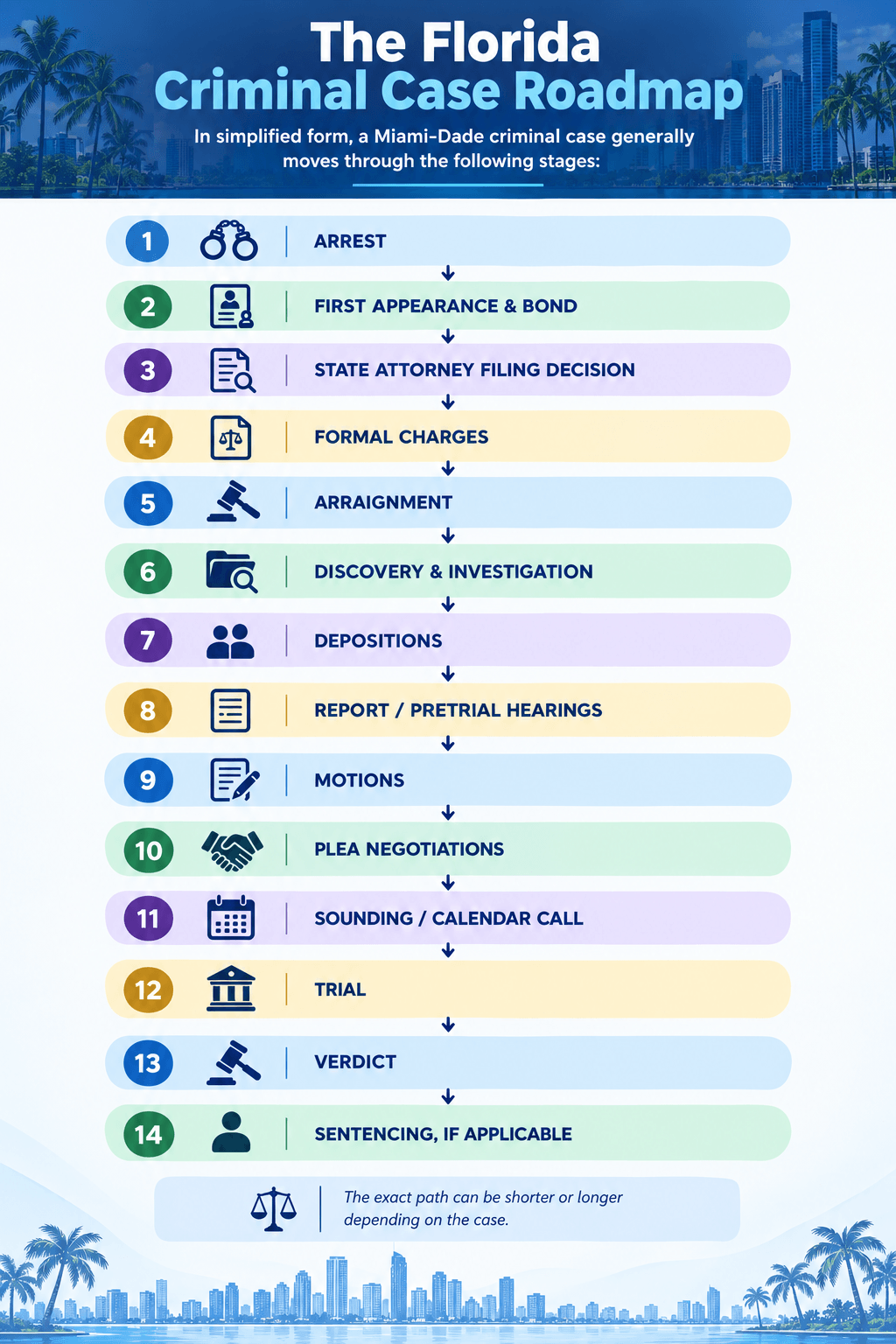
The Florida Criminal Case Roadmap
In simplified form, a Miami-Dade criminal case generally moves through the following stages:
ARREST
↓
FIRST APPEARANCE & BOND
↓
STATE ATTORNEY FILING DECISION
↓
FORMAL CHARGES
↓
ARRAIGNMENT
↓
DISCOVERY & INVESTIGATION
↓
DEPOSITIONS
↓
REPORT / PRETRIAL HEARINGS
↓
MOTIONS
↓
PLEA NEGOTIATIONS
↓
SOUNDING / CALENDAR CALL
↓
TRIAL
↓
VERDICT
↓
SENTENCING, IF APPLICABLE
Why Early Representation Can Matter
One of the biggest mistakes a person can make after an arrest is assuming that nothing important happens until the first major court date.
Important decisions can occur much earlier.
Evidence can disappear.
Video can be overwritten.
Witness memories can change.
Prosecutors can make filing decisions.
Release conditions can affect a person’s ability to work and care for a family.
Statements made shortly after an arrest can affect the remainder of the case.
For those reasons, criminal defense should begin with understanding the charges, preserving evidence, evaluating release, investigating the allegations and developing a defense strategy—not simply waiting for the case to reach trial.
Facing Criminal Charges in Miami-Dade County?
If you or a family member has been arrested or accused of a crime in Miami-Dade County, understanding the process is only the first step.
Every criminal case is different. The appropriate defense depends upon the charges, evidence, criminal history, circumstances of the arrest and applicable Florida law.
Albert Quirantes, Esq. Criminal DUI & Ticket Lawyers represents individuals facing criminal accusations in Miami-Dade County and throughout South Florida.
1815 NW 7th Street Miami, Florida 33125 Call 305-644-1800
For information about Florida criminal defense, visit CriminalDefendant.com.
Important Legal Disclaimer: This article provides general educational information about Florida criminal procedure and Miami-Dade County court practices. It is not legal advice and does not create an attorney-client relationship. Court procedures, laws, rules and individual judicial practices may change. The requirements of a particular case depend upon its facts, assigned judge and applicable law. Never miss a scheduled court appearance unless your attorney or the court has confirmed that your presence is excused.
Sources
- Florida Rule of Criminal Procedure 3.130, First Appearance
- Florida Rule of Criminal Procedure 3.131, Pretrial Release
- Florida Rule of Criminal Procedure 3.132, Pretrial Detention
- Florida Rule of Criminal Procedure 3.220, Discovery, The Florida Bar
- Florida Rules of Criminal Procedure, current consolidated publication, The Florida Bar — covers Rules 3.134, 3.140, 3.160, 3.170-3.172, 3.190, and 3.700-3.802 cited throughout