






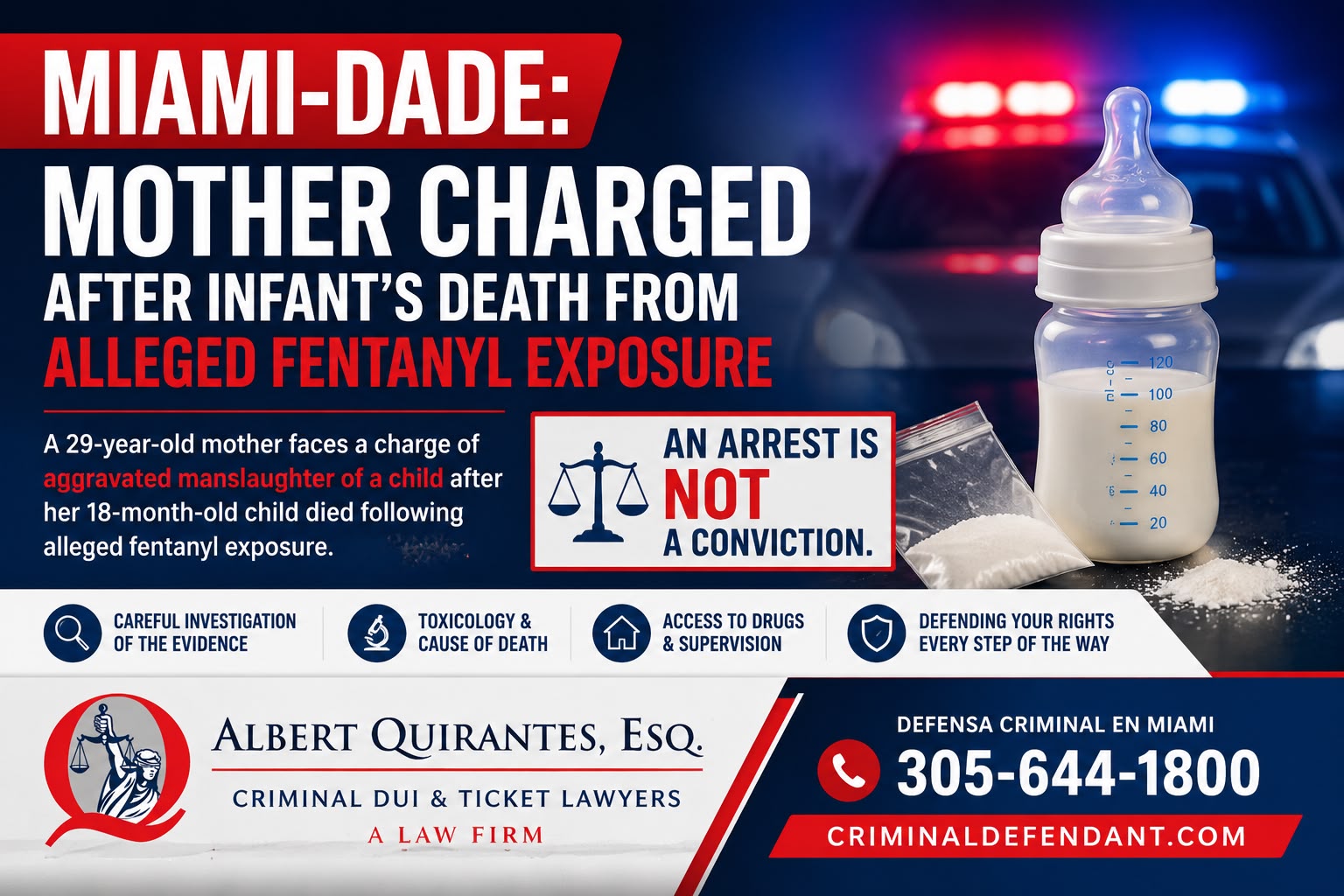
A tragic case out of Miami-Dade County is receiving significant attention after a 29-year-old mother was arrested in connection with the death of her 18-month-old child, who authorities say accidentally ingested fentanyl.
The Florida Department of Law Enforcement announced the arrest of Pearlandria Boujolly on August 20, 2026. She has been charged with one count of aggravated manslaughter of a child under 18 years of age. The Miami-Dade State Attorney’s Office is prosecuting the case, and authorities have indicated that additional charges may be forthcoming.
As serious and emotionally difficult as the allegations are, it is important to remember that an arrest is not a conviction. The State still has the burden of proving every element of the offense beyond a reasonable doubt.
What Authorities Say Happened
According to FDLE, Miami Police and Miami Fire Rescue responded to a residence at approximately 3:50 a.m. on January 3, 2026, after receiving a report of an unresponsive 18-month-old child.
The child was transported to Jackson Memorial Hospital and was pronounced dead shortly afterward.
The Miami-Dade County Medical Examiner conducted an autopsy. According to investigators, fentanyl and a trace amount of cocaine were detected in the child’s blood.
FDLE alleges that narcotics had been left inside an unlocked room in the residence and that the child accidentally ingested a small quantity of the drugs. Significantly, authorities acknowledge that Boujolly was not inside the residence when the child allegedly consumed the substances.
The investigation was conducted through FDLE’s South Florida State Assistance for Fentanyl Eradication Task Force in cooperation with the Miami Police Department.
The Charge of Aggravated Manslaughter of a Child
Aggravated manslaughter of a child is an extremely serious felony charge in Florida.
A case of this nature is different from an intentional homicide prosecution. The central issue is not necessarily whether someone intended for a child to die. Instead, prosecutors may attempt to establish criminal liability based upon alleged culpable negligence toward a child when that conduct results in death.
That distinction is important.
The prosecution must prove much more than the fact that a tragedy occurred. Criminal negligence is not automatically established simply because, in hindsight, someone could have acted differently or taken additional precautions.
The evidence must satisfy the specific requirements of Florida criminal law.
The Defense Issues That Must Be Examined
When I evaluate a case involving an alleged drug-related death, I do not begin with the headlines. I begin with the evidence.
One of the first questions is causation.
The Medical Examiner’s findings, toxicology testing, concentration of substances, timing of ingestion, and medical evidence must all be carefully examined. A toxicology report showing that a controlled substance was present is important evidence, but the defense is entitled to examine exactly what the science establishes and whether the State can prove when, where, and how the substance was ingested.
Another major issue is access.
Who was inside the residence? Who had access to the room? Who allegedly possessed the narcotics? How long were they there? Who was supervising the child? What evidence connects a particular person to the substances?
Those questions become especially important where, as FDLE itself has reported, the accused mother was not inside the residence when the child allegedly ingested the drugs.
The defense must also examine whether statements were taken, whether searches were conducted pursuant to a warrant or consent, what physical evidence was collected, and whether the State can establish the necessary connection between the defendant’s alleged conduct and the child’s death.
Probable Cause Is Not Proof Beyond a Reasonable Doubt
Following her arrest, Boujolly appeared in court and was held without bond after a judge found probable cause for the charge.
That determination should not be confused with a finding of guilt.
Probable cause is the relatively low legal threshold necessary to support an arrest and allow a prosecution to proceed. At trial, the burden is entirely different. The prosecution must prove the criminal charge beyond a reasonable doubt.
Defense counsel reportedly argued during the initial hearing that the arrest affidavit did not definitively establish when the child obtained the fentanyl or cocaine. That question could become important as discovery and forensic evidence are examined.
Fentanyl Cases Require Careful Investigation
Fentanyl has dramatically changed the landscape of drug prosecutions in South Florida. Extremely small quantities can have devastating consequences, and law enforcement agencies have devoted substantial resources to fentanyl investigations.
But the seriousness of fentanyl does not reduce the State’s burden of proof.
In a criminal courtroom, emotion cannot substitute for evidence.
A child’s death is unquestionably tragic. At the same time, our criminal justice system requires prosecutors to prove that the person charged committed the particular criminal offense alleged.
Every defendant is entitled to have the evidence tested, the forensic conclusions examined, the State’s witnesses challenged when appropriate, and all available defenses presented.
That principle is especially important in cases where the allegations themselves are capable of producing an immediate and powerful emotional reaction.
After more than three decades practicing criminal defense in South Florida, I have learned that the first version of a case presented after an arrest is rarely the entire story. The proper time to reach conclusions is after the evidence has been obtained, analyzed, and tested through the criminal justice process.
Albert Quirantes, Esq. Florida Criminal Defense Attorney CriminalDefendant.com
Sources
- FDLE official press release, S.A.F.E. Task Force arrest announcement
- Local10/NBC6, Miami-Dade mother arrested after 18-month-old son dies from fentanyl exposure
- CBS News Miami, South Florida mom charged after fentanyl, cocaine found in system of 18-month-old son
- NBC Miami, Miami-Dade mom arrested after toddler overdosed on fentanyl, cocaine
- Florida Statute 782.07(3), aggravated manslaughter of a child