







A criminal mischief accusation can begin with a brief argument, a damaged phone, a scratched car, a broken door, graffiti, or a dispute about a home or business. What looks like a property disagreement can become a criminal case carrying jail or prison exposure, restitution, probation, immigration concerns, and a permanent record.
Your next steps matter. Don’t discuss the incident on a recorded jail call, contact the property owner about changing a statement, delete messages or videos, repair or discard an item that may be evidence, or post about the dispute online without legal advice.
A Miami criminal mischief criminal defense lawyer can examine whether the damage was intentional, whether the property belonged to someone else, whether the State can identify the person responsible, and whether the claimed repair cost supports the charged degree. Early defense work can preserve surveillance footage, photographs, estimates, ownership records, messages, and witness accounts before they disappear.
Answered around the clock. Free and confidential. English or Spanish.
Early defense work can preserve video, document the property’s prior condition, test ownership and intent, challenge an inflated damage claim, and prevent avoidable mistakes.
For help from Albert Quirantes, Esq. Criminal DUI & Ticket Lawyers, call or text 305-644-1800 for a free strategy session.



Albert Quirantes has practiced criminal defense for more than 35 years, represented more than 8,000 clients, and handled numerous jury trials. His firm has over 1,400 five-star Google reviews and serves clients in English and Spanish.
Albert Quirantes, Esq. represents Criminal Mischief matters throughout Miami-Dade County.
Call us now at (305) 644-1800 for a FREE STRATEGY SESSION
Represented since 1987
English and Spanish

Under Florida Statute § 806.13, criminal mischief occurs when a person willfully and maliciously injures or damages, by any means, real or personal property belonging to another. The statute expressly includes graffiti and other acts of vandalism.
The State generally must prove more than the fact that property was damaged. It must prove the accused was the person who caused the damage, acted willfully and maliciously, and damaged property belonging to another. The State must also prove the amount or qualifying nature of the damage when that fact increases the degree of the charge.
“Willfully” focuses on intentional conduct. “Maliciously” generally requires wrongful conduct done intentionally, without legal justification or excuse. An accident, ordinary negligence, equipment failure, or an honest dispute about ownership may not establish the mental state required for criminal mischief.
The charge can involve real property, such as a residence, storefront, wall, gate, landscaping, or utility equipment, and personal property, such as a vehicle, cellphone, computer, furniture, camera, or business equipment. The method of damage can include breaking, scratching, painting, cutting, disabling, smashing, removing components, or other conduct that injures the property.
The ordinary degree of a Florida criminal mischief charge is based on the amount of damage under Florida Statute § 806.13:
If a person has one or more prior convictions under the ordinary criminal mischief subsection, a new charge that would otherwise be a second- or first-degree misdemeanor is reclassified as a third-degree felony.

The charge can involve real property
Under Florida Statute § 775.082 and Florida Statute § 775.083, ordinary statutory maximums include:
These are statutory maximums, not predictions. The actual result depends on the evidence, offense level, prior record, sentencing scores, restitution, the prosecutor’s position, the judge, and available defenses. Habitual-offender laws under Florida Statute § 775.084 may affect some felony cases.
uch as a residence, storefront, wall, gate, landscaping, or utility equipment, and personal property, such as a vehicle, cellphone, computer, furniture, camera, or business equipment. The method of damage can include breaking, scratching, painting, cutting, disabling, smashing, removing components, or other conduct that injures the property.
Florida Statute § 806.13 contains several provisions that do not depend only on the ordinary $200 and $1,000 thresholds.
Places of worship and religious articles
Willfully and maliciously damaging a church, synagogue, mosque, another place of worship, or a religious article contained there can be a third-degree felony when the damage is greater than $200. Depending on the evidence and alleged motive, the prosecution may also examine whether another enhancement statute applies.
Memorials and historic property
Damaging a qualifying memorial or historic property without the owner’s consent can be a third-degree felony when the damage is greater than $200. The statute requires restitution that includes the full cost of repair or replacement. The definition of covered property appears in Florida Statute § 806.135.
Damage connected to unlawful occupancy or trespass
A person who unlawfully detains, occupies, or trespasses upon a residential dwelling or commercial real property and intentionally causes $1,000 or more in damage can face a second-degree felony. The defense must examine both the alleged unlawful presence and the proof of intentional damage and value.
Public communications and specified facilities
The statute separately addresses certain damage to public telephones and related equipment, as well as qualifying damage to a sexually violent predator detention or commitment facility. These provisions can support felony charges under the circumstances stated in the law.
Unauthorized projection of images
Florida law also prohibits knowingly and intentionally displaying or projecting an image onto a building, structure, or other property without the owner’s written consent. An ordinary violation is a first-degree misdemeanor. If the projected image contains a credible threat as defined in Florida Statute § 784.048, the offense can be a third-degree felony. A bias-based reclassification under Florida Statute § 775.085 may also affect the case.
A court may order a person convicted of criminal mischief to pay for the damage caused. Restitution under Florida Statute § 775.089 can include losses directly or indirectly caused by the offense, subject to the statute and the evidence presented. Repair invoices, replacement costs, labor, depreciation, insurance payments, and whether the requested work exceeds the actual damage may all matter.
When the case involves graffiti, Florida Statute § 806.13 provides additional minimum fines of $250 for a first conviction, $500 for a second conviction, and $1,000 for a third or subsequent conviction. The statute also requires at least 40 hours of community service and, when possible, at least 100 hours involving graffiti removal.
For a minor found to have committed a graffiti-related delinquent act, the court may revoke, suspend, or withhold driving privileges for up to one year. Community service may reduce that period under the conditions stated in the statute. A parent or legal guardian may also be liable with the minor for the graffiti fine, subject to the court’s ability-to-pay findings.
Beyond the formal sentence, a conviction can affect employment, professional licensing, housing, school discipline, security clearances, firearm rights after a felony conviction, and immigration status. A noncitizen should obtain immigration advice before entering any plea because the exact statute, charging language, facts, sentence, and record can matter.
When the accused is under 18, a criminal mischief allegation is ordinarily handled as a delinquency matter in juvenile court under Florida Statute § 985.0301, not simply as a smaller version of an adult criminal case. The early decisions may affect detention, school, family obligations, diversion eligibility, restitution, probation, community service, treatment, and the child’s future record.
Parents and guardians should not assume that paying for the damage will automatically close the case. Restitution may be an important part of a resolution, but the State may continue the delinquency case. Before anyone contacts the owner, signs a statement, turns over a phone, or agrees to a repair amount, the child should receive legal advice.
For graffiti-related conduct, Florida Statute § 806.13 creates special consequences. The minor and parent or legal guardian may be liable for the statutory fine, subject to the court’s findings about ability to pay. The court may revoke, suspend, or withhold the minor’s driving privilege for up to one year. The statute permits a reduction through qualifying graffiti-removal community service and includes special treatment when a license is needed because of family hardship.
The defense should also examine diversion and other juvenile resolutions that may emphasize accountability and rehabilitation. Eligibility depends on the child’s age, prior history, charge, damage amount, victim input, restitution, school record, prosecutor, Department of Juvenile Justice assessment, and current local program rules. No outcome is automatic.
Adult prosecution requires separate attention. Under Florida Statute § 985.557, a prosecutor has broader discretionary direct-file authority for certain cases involving a 16- or 17-year-old. A misdemeanor may not be directly filed under that provision unless the child has at least two prior adjudications or withheld adjudications, including one involving a felony. Because criminal mischief can be charged as a felony—and a qualifying unlawful-occupancy or trespass case can be a second-degree felony—the child’s age, charged degree, prior history, and all related allegations should be reviewed immediately.
Juvenile defense should protect both the present case and the child’s future. The defense may challenge intent, identification, ownership, causation, aggregation, and inflated repair estimates while also presenting school performance, family supervision, counseling, restitution planning, and other mitigation when doing so serves the child’s interests.
1
Property can be damaged accidentally, negligently, during lawful activity, or while a person is reacting to an emergency. We examine the sequence of events, witness accounts, body-camera footage, messages, physical evidence, and the condition of the property to determine whether the State can prove intentional and malicious conduct beyond a reasonable doubt.
2
A property owner may discover damage after the accused has left and assume who caused it. Poor-quality surveillance, darkness, obstructed views, neighborhood conflict, and emotionally charged statements can produce mistaken accusations. We compare video, timestamps, access logs, location data, fingerprints, photographs, and witness descriptions.
3
The State must prove the property belonged to another. Shared homes, relationships, businesses, leases, jointly titled vehicles, and family property can create complicated ownership and permission issues. Ownership alone does not automatically resolve every issue, but deeds, titles, leases, receipts, account records, messages, and prior practices can change the analysis.
4
The accused is not responsible for preexisting damage, normal wear, later damage, poor maintenance, or work performed by someone else. Before-and-after photographs, inspection reports, repair histories, weather information, expert review, and competing estimates may show that the claimed loss was not caused by the alleged act.
5
The prosecution must prove the threshold that supports the charged offense. A replacement quote does not always prove that complete replacement was necessary. We examine repair costs, labor, parts, depreciation, fair market value, salvage, insurance records, and whether an estimate includes upgrades or unrelated work. Reducing the proven damage below a statutory threshold can reduce the degree of the charge.
6
Florida law allows damage to property owned by separate people to be combined when it occurred during one scheme or course of conduct. We examine whether the incidents were truly connected, whether each item was actually damaged by the accused, and whether the State’s total is supported by admissible evidence.
7
Police may obtain cellphone data, social-media records, location information, property, or statements only as permitted by law. If officers conducted an unlawful search, exceeded the scope of consent or a warrant, or obtained a statement in violation of constitutional protections, the defense may seek suppression when the facts and law support it.
8
Depending on the facts, consent, necessity, defense of self or others, lack of ownership proof, mistake, or another legal justification may be relevant. A defense must fit the evidence and the law; it should not be raised as a slogan without a factual basis.
1
A criminal mischief case may begin with an arrest, a notice to appear, or an investigation after the property owner reports damage. Police may collect photographs, estimates, surveillance footage, messages, recordings, and witness statements. Do not try to explain the facts to law enforcement without legal advice.
2
If a person remains in custody, the person generally appears before a judge within 24 hours under Florida Rule of Criminal Procedure 3.130. The judge may review probable cause, bond, stay-away provisions, property restrictions, and other release conditions. Follow every court order unless the judge changes it.
3
An arrest does not require the State Attorney to file the same charge or degree listed by police. The prosecutor may file a different degree, add related charges, or decline prosecution. Early defense work can provide photographs, ownership evidence, repair information, witness accounts, or other context before that decision.
4
At arraignment, the court identifies the formal charge and receives a plea. Defense counsel often files a written not-guilty plea and may waive the client’s appearance when the rules and judge permit it.
5
The defense reviews police reports, body-camera footage, surveillance video, photographs, estimates, invoices, insurance records, ownership documents, digital evidence, and witness statements. We may inspect the property, preserve electronic evidence, interview witnesses, and obtain an independent estimate or expert review when appropriate.
6
Depending on the evidence, the defense may seek suppression of evidence or statements, exclusion of unreliable or unauthenticated material, modification of release conditions, or dismissal when the law and undisputed facts permit it. Each motion requires a sound factual and legal basis.
7
Some cases may qualify for a diversion program, reduced charge, restitution-based agreement, or another negotiated resolution. Eligibility depends on the charge, prior record, amount and type of damage, victim input, prosecutor, and current program rules. Paying for damage does not automatically erase a criminal case, so any payment or agreement should be handled carefully.
8
If the case does not resolve, the defense can take it to trial and require the State to prove every element beyond a reasonable doubt. A case may also end through a no-action filing decision, dismissal, diversion, negotiated plea, or court ruling, depending on its facts.
Your defense may turn on intent, ownership, identification, causation, and a repair estimate that changes the charge from a misdemeanor to a felony. You need a criminal defense team that can investigate the property evidence, challenge unsupported valuations, and prepare the case for litigation.
Albert Quirantes has practiced criminal defense for more than 35 years, represented more than 8,000 clients, and handled numerous jury trials. His firm has over 1,400 five-star Google reviews and serves clients in English and Spanish from its Miami office.
The attorney team includes Stephen Millan, a former Miami-Dade Circuit Court judge and former prosecutor; Arthur Spiegel, a former prosecutor and former public defender with more than 40 years of experience; Jorge E. Alonso, a bilingual attorney with more than 40 years of experience who was born in Havana; and Jonathan Ibañez, a criminal defense trial lawyer whose work includes legal technology and AI-based defenses. The team brings courtroom experience, prosecutorial insight, local knowledge, and modern evidence analysis to criminal mischief cases.
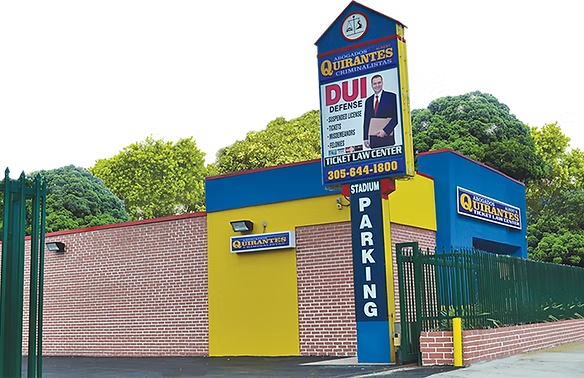
Albert Quirantes, Esq. Criminal DUI & Ticket Lawyers is located at 1815 NW 7th Street, Miami, FL 33125.

Criminal mischief is the name of the Florida offense that covers willful and malicious damage to another person’s real or personal property. Vandalism and graffiti are common forms of conduct charged under the criminal mischief statute.
Accidental damage alone generally does not establish the required willful and malicious mental state. The surrounding conduct, statements, physical evidence, and credibility of witnesses determine whether the State can prove intent.
Yes. Damage of $1,000 or more is ordinarily a third-degree felony. Felony treatment can also apply in special situations, including qualifying prior convictions, certain damage to religious or historic property, and specified damage connected to unlawful occupancy or trespass.
The State may use testimony, photographs, invoices, repair estimates, replacement costs, labor, parts, and other evidence. The defense can challenge whether the work was necessary, whether the amount includes unrelated damage or upgrades, and whether repair rather than replacement was appropriate.
The property owner can share information and preferences with the prosecutor, but the State Attorney controls the criminal prosecution. A recantation or request not to prosecute does not automatically end the case.
Restitution can be important, but an unplanned payment, apology, or message may be treated as evidence. Speak with defense counsel before contacting the owner or paying a disputed amount.
Joint ownership, possession, and permission can create important factual and legal issues, but they do not automatically defeat or establish a charge. Titles, leases, receipts, account records, messages, and the nature of the property should be reviewed.
Florida law allows damage to property owned by separate people to be aggregated when it occurred during one scheme or course of conduct. The defense can challenge whether the incidents were connected and whether each amount was proven.
An ordinary adult criminal mischief charge does not automatically suspend a Florida driver license. Special rules allow a court to revoke, suspend, or withhold a minor’s driving privilege for up to one year in certain graffiti cases.
Eligibility depends on the exact charge, disposition, prior record, and statutory exclusions. A dismissal or no-action decision may permit expungement in some cases, while an adjudication of guilt can create a major barrier. Obtain a case-specific review before relying on sealing or expungement.
It can. The immigration analysis may depend on the statutory subsection, alleged facts, intent language, damage, sentence, and the person’s status and record. A noncitizen should obtain coordinated criminal and immigration advice before accepting a plea.
Early defense work can preserve video, document the property’s prior condition, test ownership and intent, challenge an inflated damage claim, and prevent avoidable mistakes.
For help from Albert Quirantes, Esq. Criminal DUI & Ticket Lawyers, call or text 305-644-1800 for a free strategy session.