






What Is a Third-Degree Felony in Florida?
A third-degree felony is Florida’s lowest felony classification, but the word “lowest” should not be confused with minor.
A conviction can result in state prison, probation, a $5,000 fine, and a permanent felony record. It can also affect employment, professional licenses, housing, immigration status, and the right to possess a firearm.
Common examples include grand theft of property valued at $750 or more but less than $20,000, possession of cocaine or another controlled substance without a valid prescription, felony battery, fleeing or attempting to elude, and unarmed burglary of an unoccupied structure or conveyance.
These offenses share the same five-year maximum, but they do not necessarily carry the same likely sentence. Florida assigns each offense its own severity level, and some third-degree felonies score much more severely than others.
What Is the Maximum Penalty?
Florida Statute § 775.082 provides that a third-degree felony is punishable by up to five years in state prison.
The general maximum fine is $5,000 under § 775.083. A higher amount may be authorized by another statute or calculated from the financial gain obtained or loss caused by the offense. The court may also order restitution, costs, and other assessments.
Most third-degree felonies do not carry a mandatory minimum sentence, but there are important exceptions. Certain firearm offenses, repeat-offender classifications, and specific crimes can require additional punishment or restrict the judge’s discretion.
For example, burglary of a conveyance is generally a third-degree felony. If the State proves actual possession of a firearm and the requirements of § 775.087 are satisfied, a three-year mandatory minimum may apply.
The five-year statutory maximum is only the starting point. The specific offense, enhancements, prior record, and scoresheet must all be examined before anyone can determine the real exposure.
How Does the Criminal Punishment Code Apply?
Third-degree felonies are sentenced under Florida’s Criminal Punishment Code.
Every felony is assigned a severity level from 1 through 10. If a third-degree felony is not specifically listed on the offense severity ranking chart, it defaults to Level 1 under § 921.0023. Many commonly charged third-degree felonies have been assigned higher levels by the Legislature.
The primary offense supplies the initial points. Additional points may be added for other pending offenses, victim injury, prior convictions, legal status, probation violations, firearm possession, and other factors.
If the total exceeds 44 points, the Criminal Punishment Code formula produces a lowest permissible prison sentence. A third-degree felony can therefore require state prison even though the maximum sentence is only five years.
The scoresheet needs to be checked carefully. An old conviction may have been assigned the wrong level. An offense may have been included twice. Victim injury points may lack support. A legal status assessment or firearm enhancement may not apply.
A third-degree felony should never be treated casually simply because it falls at the bottom of Florida’s felony classifications.
What Is the 22-Point Nonstate Prison Rule?
Florida Statute § 775.082(10) provides important protection for some people charged with third-degree felonies.
If the total scoresheet is 22 points or fewer, the offense is not a forcible felony, and the charge is not a third-degree felony under Chapter 810, the court generally must impose a nonstate prison sanction. The judge can impose state prison only by making written findings that a nonstate prison sentence could present a danger to the public.
A nonstate prison sanction may include probation, community control, county jail, treatment, or another lawful sentence that does not send the defendant to Florida State Prison.
The rule does not apply to every third-degree felony. Burglary and other Chapter 810 offenses are specifically excluded. Forcible felonies are also excluded. A person with more than 22 points does not receive this protection.
Even when the statute applies, the objective is not simply to avoid state prison. The defense should still pursue the best result available, which may include dismissal, diversion, a reduced charge, a withhold of adjudication, or a sentence that avoids unnecessary jail.
Can the Judge Impose a Downward Departure?
A downward departure may be available under § 921.0026 when the scoresheet calls for prison and a legally recognized basis exists.
The fact that an offense was nonviolent is not enough by itself. Having no prior record is favorable mitigation, but it does not automatically authorize a departure. Paying restitution is also important, but full payment alone does not necessarily create a legal ground.
A departure may be justified when the offense was an isolated incident, was committed in an unsophisticated manner, and the defendant has shown remorse. Other grounds may include a relatively minor role as an accomplice, extreme duress, substantial impairment, cooperation with the State, or a qualifying need for specialized treatment.
In a property case, the need to pay restitution may support departure when it outweighs the need for imprisonment. Certain nonviolent defendants with 60 points or fewer may also qualify for a treatment-based drug court departure if they meet the statutory requirements.
The facts supporting the departure must be proven. The judge must identify the legal ground and place the required reasons on the record.
Can Adjudication Be Withheld?
A withhold of adjudication may be possible in some third-degree felony cases. It is not guaranteed, and eligibility depends on the charge, the defendant’s record, the terms of any agreement, and Florida’s statutory restrictions.
A withhold means the court does not formally adjudicate the person guilty, even though the person may be placed on probation and required to complete conditions.
That distinction can be important, but a withhold does not erase the case. It also does not guarantee that the record can later be sealed. Some offenses are ineligible for sealing regardless of whether adjudication was withheld.
Before accepting a plea, the client should understand whether adjudication will be withheld, whether the offense can eventually be sealed, and what consequences may remain for employment, licensing, immigration, and firearm possession.
A Cocaine Possession Case Shows Why the Facts Matter
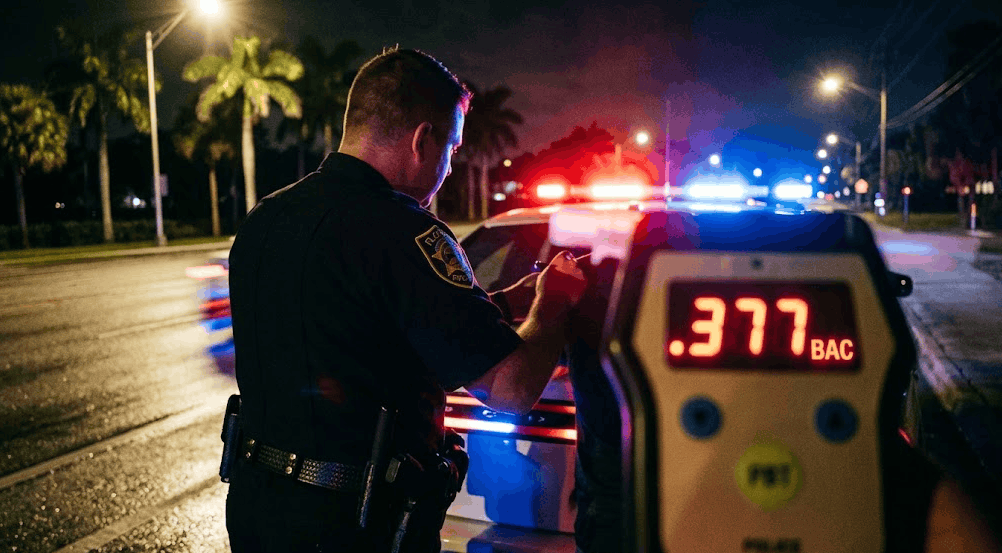
Consider a traffic stop in Miami-Dade County where police find a small quantity of cocaine inside the vehicle.
The State must prove more than the presence of cocaine in the car. It must establish that the accused person knew the substance was there and had actual or constructive possession of it.
If the cocaine was found in a pocket or personal container, the possession issue may be straightforward. If it was found under a passenger seat, inside a shared console, or in an area accessible to several people, the analysis changes.
The defense should examine the reason for the traffic stop, the legal basis for the search, the location of the substance, who owned or occupied the vehicle, fingerprints or DNA, body-camera recordings, and any statements attributed to the occupants.
If the stop or search was unlawful, the defense may file a motion to suppress. If the State cannot prove knowledge and control, the possession charge may fail. If the evidence is legally sufficient, a first-time offender may still be eligible for diversion, probation, treatment, or a negotiated withhold of adjudication, depending on the charge and eligibility requirements.
The maximum penalty may be five years, but that does not mean prison is the proper or inevitable result.
Why Early Defense Work Matters
A third-degree felony is often the point where early legal work can make a lasting difference.
The defense may be able to preserve video, obtain records, locate witnesses, challenge a search, dispute possession, correct the value of allegedly stolen property, or present information to the State Attorney’s Office before a final filing decision is made.
The client’s record also needs to be considered from the beginning. A quick plea that avoids jail may still create employment, licensing, immigration, or sealing problems that last far longer than the court case.
For more than 38 years, I have defended people charged with crimes in Miami-Dade County. My firm has represented more than 8,000 clients. Our legal team includes a former Miami-Dade Circuit Court judge and attorneys with decades of courtroom and jury trial experience.
We examine the charge, the evidence, the scoresheet, and the long-term effect of every proposed resolution. The goal is not merely to finish the case. It is to protect the client’s freedom, record, and future as fully as the facts and law allow.
What Should You Do Next?
Do not discuss the case with law enforcement without an attorney present. Preserve messages, photographs, recordings, receipts, location information, and witness contact information that may assist the defense.
Do not delete evidence, post about the accusation, or assume that a third-degree felony will disappear because it is the lowest felony classification.
If you or a family member is facing a third-degree felony in Miami-Dade County, call or text Albert Quirantes, Esq. Criminal DUI & Ticket Lawyers at 305-644-1800 for a free defense strategy session.
Sources
- Florida Statute § 775.082 — the five-year cap on a third-degree felony and the 22-point nonstate-prison rule at subsection (10)
- Florida Statute § 775.083 — the $5,000 general fine cap and its exceptions
- Florida Statute § 775.087 — firearm mandatory minimums, including the 3-year tier for burglary of a conveyance
- Florida Statute § 921.0022 — the Criminal Punishment Code offense severity ranking chart
- Florida Statute § 921.0023 — the Level 1 default for unranked third-degree felonies
- Florida Statute § 921.0024 — the 44-point scoresheet threshold and minimum-sentence formula
- Florida Statute § 921.0026 — statutory grounds for a downward departure
- Florida Statute § 812.014 — grand theft of property valued at $750 or more but less than $20,000
- Florida Statute § 893.13 — simple possession of a controlled substance
- Florida Statute § 784.041 — felony battery
- Florida Statute § 316.1935 — fleeing or attempting to elude a law enforcement officer
- Florida Statute § 810.02 — unarmed burglary of an unoccupied structure or conveyance
- Florida Statute § 775.08435 — restrictions on withholding adjudication for a third-degree felony