








A burglary or theft arrest can threaten your freedom, record, job, immigration status, and reputation. You may feel frightened or frustrated, especially if the police assumed that being present, possessing property, or appearing on video proved the entire case.
Your next steps matter. Don’t discuss the accusation on a recorded jail call, contact witnesses about their statements, delete messages, or consent to a phone search without legal advice.
A Miami burglary and theft lawyer can preserve surveillance footage, examine ownership and value records, challenge an unlawful search, and test whether the State can prove criminal intent. If the accusation began in Miami, Miami Beach, Hialeah, Doral, Coral Gables, Homestead, North Miami, or another Miami-Dade municipality, early local defense work can shape the case.
Answered around the clock. Free and confidential. English or Spanish.
You don’t have to face a Miami-Dade burglary or theft charge alone. The sooner the defense starts, the sooner your lawyer can preserve video, investigate access and ownership, challenge weak evidence, and protect you from avoidable mistakes.
For help from Albert Quirantes, Esq. Criminal DUI & Ticket Lawyers, call or text 305-644-1800 for a free strategy session.


Albert Quirantes has practiced criminal defense for more than 35 years, represented more than 8,000 clients, and handled numerous jury trials. The firm has received more than 1,400 five-star Google reviews and serves clients in English and Spanish.
Albert Quirantes, Esq. represents Burglary and Theft cases throughout Miami-Dade County, Broward County, and South Florida.
Call us now at (305) 644-1800 for a FREE STRATEGY SESSION
Represented since 1987
English and Spanish

Florida treats burglary and theft as different crimes. Burglary focuses on unlawful entry or remaining with criminal intent, while theft focuses on knowingly obtaining or using someone else’s property with the intent required by law.
Under Florida Statute § 810.02, burglary generally occurs when someone enters a dwelling, structure, or conveyance with the intent to commit an offense inside, unless the place is open to the public or the person has permission to enter. The statute also covers certain situations in which a person lawfully enters but then remains secretly, stays after permission has been withdrawn, or remains to commit or attempt a forcible felony.
Burglary doesn’t require breaking a door or window. It also doesn’t require the accused to complete the intended offense, but the State still must prove the required intent and every other element beyond a reasonable doubt.
Under Florida Statute § 812.014, theft occurs when someone knowingly obtains, uses, or tries to obtain or use another person’s property with the intent to deprive that person of a right or benefit, or to appropriate the property to an unauthorized use. That intent may be temporary or permanent.
The degree of either charge depends on facts such as the location, whether anyone was present, the property’s value and type, alleged weapons or violence, damage, and prior convictions. A case involving a home, vehicle, firearm, emergency equipment, or repeated theft history may be treated differently from an ordinary low-value property accusation.
Burglary is a felony in Florida. Under Florida Statute § 810.02, an unarmed burglary of an unoccupied structure or conveyance may be a third-degree felony, while burglary of a dwelling or occupied structure or conveyance can be a second-degree felony. Burglary involving an assault or battery, a dangerous weapon or explosive, or certain serious property damage may be a first-degree felony punishable by up to life in prison.
For ordinary property, theft under Florida Statute § 812.014 generally ranges from second-degree petit theft when the value is under $100, to first-degree petit theft when the value is at least $100 but under $750. Grand theft generally begins at $750, rises to a second-degree felony at $20,000, and rises to a first-degree felony at $100,000. Special property, the place where it was taken, prior theft convictions, coordinated conduct, and other statutory circumstances can change those levels.
Under Florida Statute § 775.082 and Florida Statute § 775.083, ordinary maximum penalties include:
These are statutory maximums, not predictions. Sentencing scores, prior records, release status, alleged losses, victim injury, weapon allegations, and enhancement laws can affect the actual exposure.
A court may also order restitution for loss or damage connected to the offense under Florida Statute § 775.089. Probation, stay-away orders, property restrictions, court costs, and conditions affecting where you may live or work may also apply.
An ordinary burglary or theft charge doesn’t automatically suspend a Florida driver’s license. One notable exception appears in Florida Statute § 812.014, which authorizes license suspension after a conviction for theft of gasoline, for up to six months on a first conviction and one year on a later conviction.
The case may affect employment, professional licensing, housing, school, and security clearances long after court ends. A noncitizen may also face serious immigration consequences depending on the statute, charging document, facts, plea, record, and sentence, so immigration advice should come before any plea.
Our office handles a wide range of Burglary and Theft Crime cases in Miami-Dade, including:
1
Burglary requires proof that the accused had the intent to commit an offense at the legally required time. Theft requires proof of an intent to deprive or appropriate. We examine statements, conduct, timing, receipts, access records, and surrounding facts to show mistake, confusion, lawful purpose, or another reasonable explanation.
2
Entry into a place open to the public generally isn’t burglary by itself. Permission to enter or remain, authority to use property, shared ownership, employment duties, and a good-faith belief in the right to possess an item can undermine key parts of the State’s theory.
3
Grainy video, poor lighting, masks, crowded scenes, and assumptions based on association can lead to a false identification. We compare surveillance footage, body-camera video, fingerprints, DNA, phone location data, vehicle records, and witness descriptions to test whether the State can prove who acted and what that person did.
4
The prosecutor must prove the property’s value and the facts that elevate a theft charge. We examine purchase records, age, condition, market value, depreciation, recovery of the property, and whether the item fits a category that carries different treatment under Florida law.
5
Police may search a person, vehicle, home, phone, or account only when the law permits it. When officers violate constitutional limits or obtain a statement unlawfully, we can ask the court to suppress the evidence if the facts and law support that motion.
6
Possession of property or an ordinary tool doesn’t automatically prove burglary or theft. The State must connect the accused to the required intent and conduct, and Florida Statute § 810.06 specifically requires intent to use or allow the use of tools to commit burglary or trespass.
1
After an arrest, law enforcement books the accused and submits reports and evidence to the Miami-Dade State Attorney’s Office. Don’t discuss the facts on a jail call, by text, on social media, or with anyone who may become a witness.
2
A person who remains in custody generally appears before a judge within 24 hours under Florida Rule of Criminal Procedure 3.130. The judge reviews probable cause, bond, release conditions, and restrictions involving property, locations, alleged victims, or codefendants.
Defense counsel can present Miami-Dade ties, employment, family duties, criminal history, and a release plan. Follow every court order unless the judge changes it.
3
An arrest doesn’t require the State Attorney to file the same charge listed on the arrest form. The prosecutor may file that charge, change the degree, add charges, or decline prosecution after reviewing the evidence.
Early defense work can preserve video before it is erased, document lawful access or ownership, identify witnesses, and challenge value or intent before the filing decision.
4
At arraignment, the court states the formal charge and takes a plea. Counsel often files a written not-guilty plea and may waive the client’s appearance when the rules and judge permit it.
5
The defense reviews reports, surveillance footage, body-camera recordings, property photographs, receipts, valuations, fingerprints, DNA, phone data, and witness statements. We also examine who had access, when permission changed, how police recovered the property, and whether the evidence supports the charged degree.
6
Depending on the facts, the defense may seek suppression of evidence or statements, exclusion of unreliable identification, modification of release conditions, severance from another accused person, or dismissal when the law and undisputed facts permit it. Every motion needs a sound factual and legal basis.
7
Some cases may qualify for diversion, a reduced charge, restitution-based terms, or another negotiated resolution. Eligibility depends on the charge, value, damage, prior record, victim input, prosecutor, and current Miami-Dade program rules.
You decide whether to accept a plea after counsel explains the evidence, defenses, sentencing range, record consequences, and immigration risks. No one should pressure you to plead before you understand those consequences.
8
If the case doesn’t resolve, the defense can take it to trial and require the State to prove every element beyond a reasonable doubt. A case may also end through a no-action filing decision, dismissal, diversion, negotiated plea, or court ruling, depending on its facts.
Your goal is to protect your freedom, record, livelihood, and future. You need a defense team that can move quickly to preserve evidence, expose weak assumptions, and prepare the case for litigation from the start.
Albert Quirantes has practiced criminal defense for more than 35 years, represented more than 8,000 clients, and handled numerous jury trials. His firm enjoys more than 1,400 five-star Google reviews and serves clients in English and Spanish from its Miami office.
The attorney team includes former Miami-Dade Circuit Court judge and former prosecutor Stephen Millan, former prosecutor and former public defender Arthur Spiegel, bilingual attorney Jorge E. Alonso, and criminal defense trial lawyer Jonathan Ibañez, whose work includes legal technology and AI-based defenses. The team brings courtroom experience, prosecutorial insight, local knowledge, and modern evidence analysis to Miami-Dade burglary and theft cases.
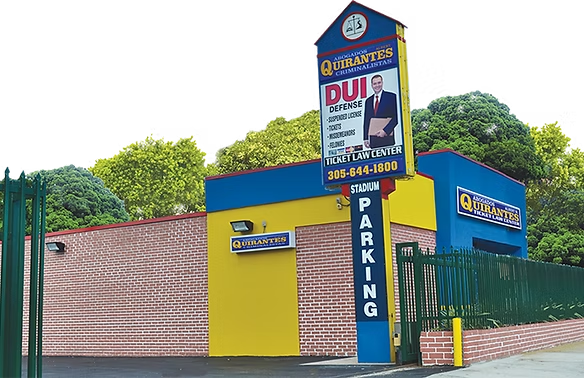
Albert Quirantes, Esq. Criminal DUI & Ticket Lawyers is located at 1815 NW 7th Street, Miami, FL 33125.

Not exactly. Florida burglary doesn’t require a broken lock, forced door, or damaged window. The State may rely on an alleged unauthorized entry or a legally covered act of remaining, but it must also prove the required criminal intent.
Yes. The State doesn’t have to prove a completed theft if it can prove an unlawful entry or remaining with the intent to commit an offense inside. The defense can challenge when that intent allegedly formed and whether the evidence proves it beyond a reasonable doubt.
Both can involve unauthorized presence, but burglary requires the additional intent described in the burglary statute. A person who entered or remained without permission didn’t necessarily intend to commit another offense.
For ordinary property, grand theft generally begins at $750. Different rules can apply based on the property’s type, where it was taken, prior convictions, coordinated conduct, an emergency, or other facts listed in the statute.
That belief may challenge the required intent if it was genuine and supported by the evidence. Messages, contracts, receipts, shared accounts, employment duties, prior practices, and witness testimony may help establish the full context.
Mere presence usually isn’t enough by itself. The State may still claim that you helped, encouraged, planned, or participated, so your words, actions, location, and relationship to the other person must be examined carefully.
Florida Statute § 812.015 permits a merchant or specified personnel to detain a suspected offender in a reasonable manner and for a reasonable time when the statutory conditions exist. That doesn’t prove guilt, and an unreasonable detention or unlawful search may raise separate legal issues.
Jail is legally possible for a misdemeanor theft, and prison is possible for felony theft or burglary, but incarceration isn’t automatic in every case. The evidence, degree, value, prior record, restitution, sentencing rules, prosecutor, judge, and available defenses all matter.
Eligibility depends on the exact offense, disposition, prior record, and statutory exclusions. A dismissal or no-action result may support expungement in some cases, while an adjudication of guilt creates a major barrier. Get a case-specific review before relying on sealing or expungement.
Yes. Property-crime pleas can create serious immigration problems depending on the statutory language, alleged facts, charging document, sentence, loss amount, and your status. Don’t enter a plea until criminal defense and immigration counsel have reviewed the proposed resolution.
The sooner the defense starts, the sooner your lawyer can preserve video, investigate access and ownership, challenge weak evidence, and protect you from avoidable mistakes.
For help from Albert Quirantes, Esq. Criminal DUI & Ticket Lawyers, call or text 305-644-1800 for a free strategy session.