









Insurance fraud is a serious white collar crime and anyone convicted of this crime faces a long period of imprisonment in a state penitentiary as well as a large fine. It is vital that you seek assistance from a Miami criminal defense attorney as soon as possible, even if you believe that you are under suspicion of committing fraud.

There are different types of insurance fraud, as follows:
Penalties for insurance fraud
Insurance fraud is a felony crime (Florida statute 817.234), but the actual severity of the crime depends on the amount of the alleged fraud in money terms. It could either be a third degree, second degree or first degree felony offense.
If the amount of money involved is less than $20,000, then the crime is a third degree felony, with up to 5 years in prison and a $5,000 fine.
Between $20,000 and $100,000 could mean a second degree felony, with up to 15 years in prison and a $10,000 fine.
Any more than $100,000 involved could mean a first degree felony, with up to 30 years in prison and a $10,000 fine.
There may be additional penalties depending on who allegedly committed the fraud. For instance, professionals such as health care practitioners, lawyers and other professionals could lose their license or have it suspended for a specific number of years. For example, if a doctor is found guilty of insurance fraud relating to a PIP claim, he or she could lose their license for 5 years and lose any PIP benefits themselves for up to 10 years.
Possible defenses against a charge of insurance fraud
The main defenses that can be used to combat an allegation of insurance fraud include the following:
You will need effective legal representation
Insurance fraud is a very serious crime in this state. You cannot risk losing your job, your freedom, or your future because of a crime you did not commit or because there is insufficient evidence that you committed it. Remember that you cannot be convicted of fraud unless prosecutors can prove your guilt ‘beyond a reasonable doubt.’ Contact Albert Quirantes, Esq. Criminal DUI & Ticket Lawyers as soon as possible if arrested or believe that you are under suspicion of insurance fraud at 305-644-1800.
An insurance fraud investigation can threaten your freedom, career, professional license, business, and immigration status. A claim submitted after a crash, storm, theft, or workplace injury can become the focus of a criminal investigation before you realize anyone suspects you.
Answered around the clock. Free and confidential. English or Spanish.
Do not wait until an insurer’s suspicions or a federal investigation become formal charges. Bring your claim documents, investigator correspondence, policy, letters from prosecutors or agents, and court papers to a free strategy session with our firm.
Call or text 305-644-1800 to speak with Albert Quirantes, Esq. Criminal DUI & Ticket Lawyers. Let us evaluate your case and discuss how we can represent you in protecting your freedom, livelihood, and future.


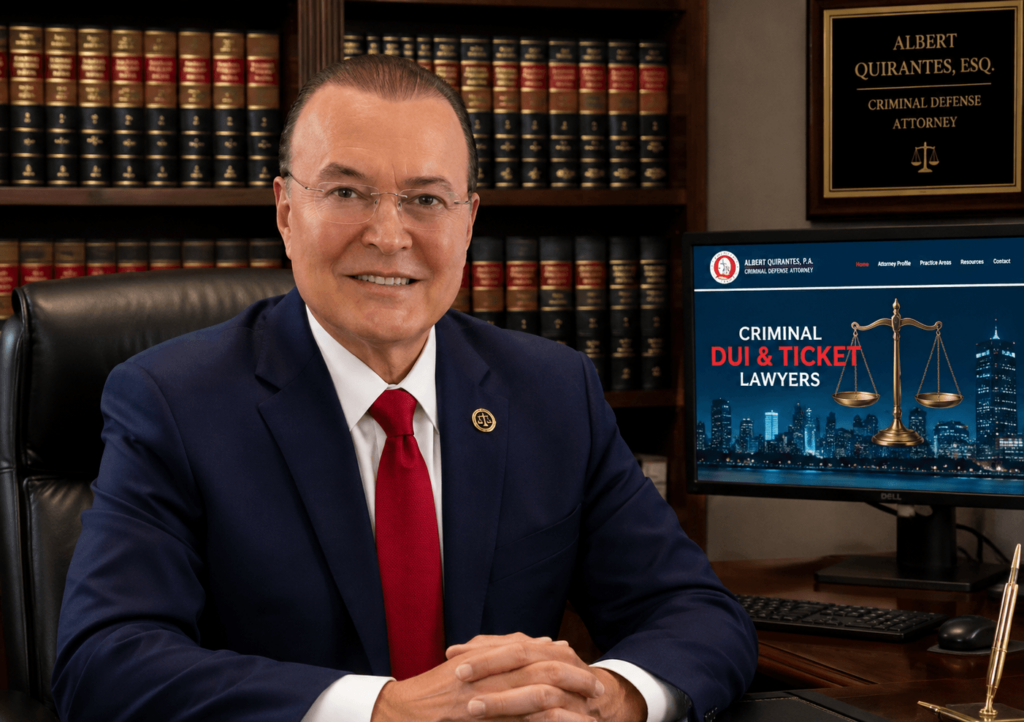
We concentrate our practice in criminal defense. At Albert Quirantes, Esq. Criminal DUI & Ticket Lawyers, we defend people accused of insurance fraud in Florida state court and in federal court. Our goal is to achieve dismissal of charges, a charge reduction, or acquittal whenever possible.
If a detective, insurance investigator, or federal agent wants to question you, get legal advice before discussing the facts. Call or text 305-644-1800 for a free strategy session. Bring the claim, notices, policy, and any documents you have received so we can identify the accusation and plan your defense.
Represented since 1987
English and Spanish

Insurance fraud is conduct the law prohibits in connection with an insurance application, claim, benefit, or related transaction. For most false-claim charges, the State must prove that the accused knowingly supplied materially false, incomplete, or misleading information, intending to injure, defraud, or deceive an insurer.
Material information is information important to the claim or application. A disputed repair estimate, an honest mistake, or a denied claim does not prove that someone committed a crime.
Florida Statute 817.234 covers many forms of conduct. These include presenting false claim statements, preparing statements intended for an insurer, giving false information on an application or concealing information it requires, and specified misconduct by health care providers, contractors, and people who solicit accident victims. The prosecutor must prove every element of the particular subsection charged beyond a reasonable doubt.
The insurer does not have to pay for a crime to occur. Some provisions punish preparing or presenting false information, so an unpaid or rejected claim can still lead to charges. On the other hand, receiving insurance money does not show that the person knew about any fraud.
Leaving something out or giving an inaccurate answer to an insurance company may seem harmless. Knowing deception about an important fact, however, can lead to criminal prosecution, even when the matter began as an ordinary insurance claim.
A material misrepresentation is a false statement about a fact important to the insurance application or claim. A material omission leaves out important information, which can make an answer incomplete or misleading. What matters is the exact question asked, the information required, and what the person knew and intended.
Florida Statute 817.234(1)(a)1. and 2. address knowingly false, incomplete, or misleading oral or written claim statements made with intent to injure, defraud, or deceive an insurer. Florida Statute 817.234(1)(a)3. addresses false application information and knowing concealment of facts material to an application.
Except for reinsurance contracts, claim forms in Florida must carry a fraud warning under Florida Statute 817.234(1)(b). That warning says this conduct is a third-degree felony. For offenses governed by subsection (11), the degree depends on the value involved; certain other provisions set their own felony degree. Under Florida Statute 817.234(11), covered offenses involving less than $20,000 are third-degree felonies, $20,000 to less than $100,000 are second-degree felonies, and $100,000 or more are first-degree felonies. The state prison penalties for each level appear below. An omission or inconsistency, standing alone, does not establish every element of the crime.
Hypothetical examples include knowingly giving a false garaging address to obtain a lower auto premium, concealing a household driver when the application requires disclosure, denying prior losses when asked, or misrepresenting a property’s occupancy or a business’s operations. These examples can support fraud allegations only when the facts prove the information was important and the applicant acted knowingly and with fraudulent intent.
We review the exact application, the wording of each question, agent communications, electronic entries, signatures, and corrections. An agent’s data entry error or a misunderstood question is very different from a knowingly false answer supplied by the applicant.
Suppose a person is asked about prior lawsuits involving the same back injury but knowingly denies an earlier injury lawsuit while seeking payment for a supposedly new injury. Or a homeowner denies a prior lawsuit or claim concerning the same roof damage while seeking hurricane benefits. These hypothetical omissions could prompt a fraud referral when they relate to the current claim and are made with fraudulent intent.
There is no blanket rule that every prior lawsuit must be volunteered in every insurance matter. We examine the request, its scope, what information was required, and how the prior case relates to the current application or claim. An unrelated lawsuit, an ambiguous question, or an innocent memory lapse is not proof of fraud.
An examination under oath is sworn questioning that an insurer may require under the insurance policy. A deposition is sworn testimony taken as part of a lawsuit or other legal proceeding. Either one creates a recorded account that investigators can compare with documents and earlier statements.
Hypothetical examples include knowingly denying prior treatment for the same injury, denying an earlier claim for the same damage, or claiming that repairs were completed when they were not. Sworn testimony presented in support of an insurance claim can fall under the claim-statement provisions of Florida Statute 817.234(1)(a) when every element is proven. Being under oath does not turn every discrepancy into insurance fraud.
Under Florida Statute 626.989(6), insurers that know or believe that specified insurance fraud has occurred must report it to the Division of Criminal Investigations of the Florida Department of Financial Services. The division reviews referrals, investigates selected reports independently, and reports violations it uncovers to the appropriate prosecutor. The insurer does not decide whether criminal charges will be filed.
For example, an insurer could compare an examination-under-oath transcript denying prior injury litigation with a court file concerning that injury, then send the discrepancy and supporting records for investigation. Investigators still must decide whether the evidence supports each element of a crime.
Before an application, recorded statement, examination under oath, or deposition becomes a criminal case, get legal advice. We review the full record, assess the alleged omission, and help you meet your policy cooperation obligations without increasing your criminal exposure. Call or text 305-644-1800 for a free strategy session.
1
Personal injury protection, or PIP, is automobile insurance coverage that pays certain injury-related benefits under Florida law. PIP fraud allegations may concern claimed treatment, billing, passenger identities, accident circumstances, or clinic documents.
We examine whether the client knew a statement was false, whether the claimed treatment occurred, and who created or approved each record. Being a passenger, visiting a clinic, or signing a document does not, without more, establish knowing participation in a fraudulent scheme.
2
Florida Statute 817.234(9) separately prohibits organizing, planning, or knowingly participating in an intentional motor vehicle crash, or a scheme to document a crash that never occurred, for the purpose of making motor vehicle injury claims or PIP claims. This offense carries a mandatory minimum of two years in state prison, explained below.
A real collision with inconsistent witness accounts is not the same as a staged crash. We compare vehicle damage, video, crash reports, medical records, messages, and the timing of the claim to determine whether the evidence supports the accusation.
3
These investigations may involve roof damage, water intrusion, fire loss, stolen property, repair invoices, photographs, or alleged preexisting damage. Contractors and property owners can face different theories of liability based on their own conduct and knowledge.
We review what existed before the loss, what the policyholder reported, who prepared the estimate, and whether the disagreement concerns coverage or alleged deception. Florida Statute 817.234(7)(d) separately makes it a third-degree felony, punishable by up to five years in state prison, for a contractor, or someone acting on the contractor’s behalf, to knowingly or willfully and with intent to injure, defraud, or deceive pay, waive, or rebate all or part of a deductible applicable to payment to the contractor for repairs to property covered by a property insurance policy.
4
After a hurricane, investigators may question whether roof damage, flooding, damaged contents, temporary housing expenses, or repair charges were caused by the storm. Allegations can involve overstated losses, altered photographs, false invoices, duplicate requests for the same expense, or presenting old damage as new hurricane damage.
A disagreement about wind damage, wear and tear, flood coverage, or repair pricing does not prove knowing fraud. We compare photographs taken before and after the storm, weather data, inspection reports, maintenance records, receipts, and communications with adjusters and contractors. We also determine who supplied each disputed statement and whether the insured knew it was inaccurate.
Some accusations involve a homeowner who relied on a contractor’s estimate or explanation. That reliance must be examined in context. We investigate knowledge, intent, and the claim’s actual history under Florida Statute 817.234, rather than assuming an inflated estimate proves the homeowner committed a crime.
Hurricane claims can also draw federal attention. When a claim involves benefits connected to a presidentially declared major disaster or emergency, federal mail and wire fraud charges carry higher maximum penalties, as explained in the federal section below.
5
Providers, clinic personnel, and others may be accused of billing for services not rendered, falsifying treatment records, or knowingly helping a false claim. A coding dispute or employee error requires careful investigation into who knew what and who controlled the billing process.
We review appointment records, treatment notes, billing histories, access logs, contracts, and payment records. We also consider the effect of a criminal resolution on any separate licensing proceeding. Health care billing cases are frequently prosecuted in federal court, so we evaluate federal exposure from the start.
6
Workers’ compensation provides benefits for qualifying work-related injuries and illnesses. Florida Statute 440.105 prohibits specified conduct involving false benefit statements, coverage, payroll, worker classifications, identity information, and assistance in fraud.
A worker’s physical activity in a short surveillance clip does not establish every element of a false-benefit charge. We compare the footage with the actual statement, medical restrictions, dates, and full context. Employer cases may require a separate analysis of coverage duties, payroll records, and the knowledge required by the charged provision.
7
Public assistance fraud concerns alleged misuse of government benefit programs. It is a separate category from private insurance fraud, but investigations can overlap when they involve medical benefits, income information, injury claims, or payments from multiple sources.
Florida Statute 414.39 addresses specified knowing misconduct involving eligibility information, changes in circumstances, unauthorized use of benefit cards, and false claims for services. Examples can involve food assistance, Medicaid eligibility, or temporary cash assistance. We examine the actual reporting requirement, notices, household and income records, transaction history, and what the person knew.
For most of these offenses, the statute adds up the value involved over any 12 consecutive months. Less than $200 is a first-degree misdemeanor, punishable by up to one year in county jail. From $200 to less than $20,000 is a third-degree felony; $20,000 to less than $100,000 is a second-degree felony; and $100,000 or more is a first-degree felony. The state prison maximums for those felony levels appear below.
An agency overpayment finding does not establish every element of a criminal charge. However, repayment is expressly not a defense or ground for dismissal under Florida Statute 414.39(7). Get legal advice before signing an admission, repayment agreement, or benefits-related statement that could affect a criminal investigation.
8
Florida Statute 817.233 makes it a crime to willfully burn, attempt to burn, or help burn property that was insured against loss or damage by fire at the time with intent to injure or defraud the insurer. It is a third-degree felony, punishable by up to five years in state prison. A fire can also lead to arson and other charges, so we investigate its cause and the client’s alleged role rather than treating ownership of the property or financial pressure as proof.
For offenses governed by the value-based levels in Florida Statute 817.234(11), the felony degree depends on the value of the property involved. Workers’ compensation fraud under Florida Statute 440.105(4)(f) uses the same value thresholds.
Under the ordinary maximums in Florida Statute 775.082 and Florida Statute 775.083:
Certain conduct carries its own degree regardless of these value levels. The value alleged, the specific provision, prior record, sentencing scores, additional counts, and lawful enhancements can all change the actual prison exposure. A court may also impose a fine of up to double the gain from the offense or the victim’s loss.
Some violations of the workers’ compensation statute that do not involve fraud are first-degree misdemeanors, punishable by up to one year in county jail. The specific conduct and subsection determine the charge.
A mandatory minimum is the lowest sentence the law requires the judge to impose when its conditions are met. The judge cannot go below it, even if the judge believes a lower sentence would be fair.
Florida Statute 817.234(9) makes the staged-crash or nonexistent-crash scheme a second-degree felony and requires a minimum of two years in state prison upon conviction. Florida Statute 817.234(8)(a) imposes the same second-degree felony and two-year minimum state prison term for soliciting business from people involved in motor vehicle accidents to make, adjust, or settle motor vehicle tort claims or PIP claims, with intent to defraud another person. A motor vehicle tort claim is a civil claim seeking compensation for harm caused by a vehicle accident.
These mandatory minimums do not apply to every insurance fraud accusation. We identify the exact subsection and evidence before evaluating sentencing or any proposed plea.
Restitution is court-ordered repayment for losses connected to an offense. Florida Statute 775.089 governs criminal restitution, including disputes about the amount and its connection to the offense.
Florida Statute 817.234 also provides civil remedies for insurers and civil penalties in motor vehicle insurance cases. For the staged-crash offense, the civil penalty is at least $15,000 and no more than $50,000. These financial consequences are separate from criminal fines and state prison exposure.
A licensed health care practitioner found guilty of PIP-related insurance fraud loses the license to practice for five years and cannot receive PIP reimbursement for ten years. Other professionals may face separate disciplinary proceedings.
A plea can also affect employment, business relationships, housing, and immigration status. Noncitizens should obtain coordinated criminal defense and immigration advice before accepting any resolution.
Insurance fraud is not only a state crime. The same conduct can be prosecuted in federal court, and federal cases often carry longer prison exposure, generally no parole, and aggressive investigative tactics. Albert Quirantes is admitted to practice in the U.S. District Court for the Southern District of Florida, where Miami federal cases are filed.
Federal prosecutors can bring charges when an alleged scheme uses the mail, interstate wires such as email, electronic claim submissions, or bank transfers, or involves a health care benefit program. Cases involving Medicare, Medicaid, the National Flood Insurance Program, or FEMA disaster assistance are especially likely to be investigated federally.
Federal investigations are often handled by the FBI, the Office of Inspector General of the U.S. Department of Health and Human Services, or the U.S. Postal Inspection Service. Because Florida and the federal government are separate sovereigns, a state case does not necessarily prevent a federal prosecution for the same conduct.
Health care fraud. Under 18 U.S.C. 1347, it is a federal crime to knowingly and willfully execute, or attempt to execute, a scheme to defraud a health care benefit program in connection with the delivery of or payment for health care benefits, items, or services. Under 18 U.S.C. 24, that term includes public or private plans or contracts affecting commerce, so private insurance can qualify as well as Medicare and Medicaid. The ordinary maximum is 10 years in federal prison. If the violation results in serious bodily injury, the maximum is 20 years in federal prison; if it results in death, the maximum is life in federal prison.
Mail fraud and wire fraud. Under 18 U.S.C. 1341 and 18 U.S.C. 1343, each mailing or transmission in interstate or foreign commerce made to execute a fraudulent scheme can be charged as a separate count, with up to 20 years in federal prison per count. When the fraud involves benefits connected to a presidentially declared major disaster or emergency, such as certain hurricane-related payments, the maximum rises to 30 years in federal prison and a fine of up to $1,000,000.
Conspiracy and attempt. A conspiracy is an agreement to commit a crime; an attempt involves intending to commit it and taking a substantial step toward doing so. Under 18 U.S.C. 1349, conspiring or attempting to commit these fraud offenses carries the same penalties as the completed crime, even if the scheme never succeeded.
False statements to federal agents. Under 18 U.S.C. 1001, knowingly and willfully making a materially false statement in a matter within federal jurisdiction can be a separate crime, even if the underlying fraud is never proven. Material means important to the government matter being investigated or decided. The ordinary maximum is five years in federal prison; specified terrorism matters and certain sex-offense or human-trafficking matters can carry up to eight years in federal prison. The statute also contains exceptions that must be considered in the particular case.
Federal sentences for offenses committed on or after November 1, 1987, generally do not include parole, meaning release by a parole board before the sentence ends. Under 18 U.S.C. 3624(b), eligible prisoners may earn up to 54 days of good-conduct credit for each year of the sentence imposed, subject to statutory conditions. Separate earned time credits under 18 U.S.C. 3632(d)(4) may allow eligible prisoners to transfer earlier to prerelease custody or supervised release. Eligibility and application depend on the offense, participation, risk assessments, and other legal requirements. There is no single percentage that predicts how long every person will remain in a federal prison facility.
Federal sentences are calculated under the U.S. Sentencing Guidelines. These are advisory rules that recommend a sentencing range based largely on the amount of loss, the number of victims, the person’s role, and criminal history. In fraud cases, the loss amount often drives the sentence more than any other factor, so we examine how the government calculates it.
Under 18 U.S.C. 3663A, mandatory restitution generally applies to covered federal property offenses, including fraud, when an identifiable victim has suffered injury or financial loss, subject to the statute’s exceptions. Restitution compensates the victim for legally recoverable losses connected to the offense.
A target letter is a written notice from a federal prosecutor stating that you are a target of a grand jury investigation, meaning the prosecutor has substantial evidence linking you to a crime. A grand jury subpoena is a court order requiring you to produce documents or testify. If you receive either one, or if federal agents contact you, call a criminal defense lawyer before responding.
Early federal representation can make a real difference. Before charges are filed, counsel may be able to present information to the prosecutor, address the loss calculation, and protect you from statements that create new charges.
You may remain silent and request an attorney before answering substantive questions from police or government agents. Whether questioning must stop depends on the legal setting, including whether you are in custody. Do not lie, obstruct an investigation, or disregard a lawful order. A knowingly and willfully made material false statement in a matter within federal jurisdiction can create a separate charge under 18 U.S.C. 1001.
An insurance company’s investigator is not necessarily a government agent. Your policy may require cooperation, records, or an examination under oath. Criminal exposure and policy obligations must be considered together, so let counsel review the request before you respond or refuse to participate.
Preserve original photographs, messages, estimates, receipts, medical records, claim submissions, and devices. Do not delete material, alter documents, create replacement evidence, or coordinate accounts with other people. Ask your lawyer how to preserve business records and video that may be overwritten.

1
We examine whether the evidence shows knowing deception or instead shows a mistake, a misunderstanding, reliance on another person’s information, or an ordinary claim dispute. Each explanation must be supported by the facts.
2
The prosecution must identify the allegedly false statement or omission and connect it to the legal elements. We compare the original question, the complete answer, the policy, the submission history, and the claim file. An excerpt can create a misleading impression when separated from the full exchange.
3
Shared employment, clinic attendance, family relationships, or presence at a collision do not prove knowing participation. We investigate who prepared, transmitted, approved, and benefited from each document, and what the client actually knew.
4
We review original files, timestamps, account access, photographs, surveillance, and the handling of evidence. Edited images, incomplete footage, and software-generated fraud alerts require scrutiny. An automated alert is an investigative lead, not proof of the charged elements.
5
The amount claimed, the amount paid, the restitution demand, and the legally relevant value are not necessarily the same. We examine the calculation and challenge unsupported assumptions that raise the felony degree in state court or the guideline range in federal court.
Suppression means asking the court to exclude evidence obtained in violation of your legal protections. When the facts support it, we seek suppression of unlawfully obtained evidence or statements and challenge unreliable evidence through appropriate motions.

We begin by reviewing the investigation, the charge, the records, and any immediate risks. Early defense work may preserve evidence and present supported information to the prosecutor before a filing decision.
If charges are filed, we address release conditions, obtain discovery, investigate witnesses and records, and prepare appropriate motions. Discovery is the exchange of evidence and case information between the prosecution and the defense under the court’s rules.
We evaluate dismissal, reduced charges, trial, and any lawful diversion or negotiated option. Diversion is a program that can offer an alternative to ordinary prosecution when eligibility requirements and completion terms are met. Availability depends on the charge, record, prosecutor, facts, and the specific program. Paying money back does not end a criminal case on its own.
You decide whether to accept a plea after we explain its consequences. If trial is necessary, we hold the prosecution to its burden of proving every element beyond a reasonable doubt.

A minor can become involved in an accusation concerning a staged crash, a passenger list, a false claim, or information submitted at an adult’s direction. We investigate the child’s age, understanding, communications, and actual participation, including whether an adult supplied or controlled the information.
Juvenile delinquency proceedings address alleged law violations by children and have different procedures and outcomes from adult criminal court. Adult state prison maximums should not be treated as the expected result of a juvenile case.
Florida Statute 985.125 authorizes postarrest diversion programs, but a particular child and charge must qualify under the applicable program. The prearrest citation program in Florida Statute 985.12 is limited to qualifying misdemeanors; it is not available for felony insurance fraud.
Direct file means a prosecutor files charges against a juvenile in adult criminal court under statutory authority. Florida Statute 985.557 permits discretionary direct file for certain youths, including 16- and 17-year-olds charged with felonies. We evaluate adult-court exposure early and work to protect the child’s education, record, and future.

Albert Quirantes has more than 35 years of criminal defense experience and has handled more than 8,000 cases, including numerous jury trials. We concentrate our practice in defending criminal cases in state and federal court, and we prepare each insurance fraud matter around its actual documents, witnesses, and legal issues.
Our attorney team includes Stephen Millan, a former Miami-Dade Circuit Court judge and former prosecutor; and Arthur Spiegel, a former assistant public defender who began his career as a certified legal intern in the Miami-Dade State Attorney’s Office.
Jorge E. Alonso: A criminal defense attorney who has defended the accused in Miami-Dade state and federal courts for more than 40 years. He has tried more than 100 jury trials to verdict and is fully bilingual in English and Spanish.
Jonathan Ibáñez, Esq.: A bilingual criminal defense trial lawyer and member of The Florida Bar, fluent in English and Spanish. A native of South Florida, he brings knowledge of technology and its legal applications to challenging evidence in Florida courts.
We help you understand the accusation, organize the records, and make informed decisions about your defense. Albert Quirantes, Esq. Criminal DUI & Ticket Lawyers is located at 1815 NW 7th Street, Miami, FL 33125. We serve clients in English and Spanish.
Yes. Some provisions of Florida’s insurance fraud law punish preparing or presenting false information, whether or not the insurer paid. Payment matters, but it does not answer every charging question.
No. Insurers deny claims for many reasons, including coverage disputes and insufficient documentation. A criminal conviction requires proof of every element of the charged offense.
Yes. An honest mistake can defeat the knowledge or intent the prosecution must prove. We examine the records and circumstances rather than relying on the word “mistake” alone.
No. Value-based offenses can be first-, second-, or third-degree felonies, and some conduct has its own degree. Staged-crash allegations carry a mandatory minimum of two years in state prison under Florida Statute 817.234(9).
Yes. A qualifying scheme can support federal charges. The ordinary maximum for health care fraud under 18 U.S.C. 1347 is 10 years in federal prison, with higher limits when serious injury or death results. Mail fraud under 18 U.S.C. 1341 and wire fraud under 18 U.S.C. 1343 ordinarily carry up to 20 years in federal prison per qualifying count, with higher limits for specified disaster-related or financial-institution cases. Parole generally is unavailable for federal offenses committed on or after November 1, 1987.
Get legal advice first. A private insurer’s request can involve contractual cooperation duties, while your statements may also reach state or federal criminal investigators. We review both issues before advising you how to respond.
Yes, but being a passenger does not prove knowing participation. The evidence must establish the charged conduct and the required intent.
Repayment may matter in negotiations or restitution, but it does not require dismissal. Discuss any repayment or settlement with defense counsel before making admissions or signing documents.
Possibly. Sealing hides a criminal record from the public while certain agencies can still see it. Expunction removes the record, except for a confidential copy kept by the Florida Department of Law Enforcement. A withheld adjudication means the judge accepted a plea or finding of guilt but did not formally convict. Eligibility for record relief depends on the exact charge, outcome, and prior record, so ask for an individual review. Federal convictions cannot be sealed or expunged under Florida law.
Do not wait until an insurer’s suspicions or a federal investigation become formal charges. Bring your claim documents, investigator correspondence, policy, letters from prosecutors or agents, and court papers to a free strategy session with our firm.
Call or text 305-644-1800 to speak with Albert Quirantes, Esq. Criminal DUI & Ticket Lawyers. Let us evaluate your case and discuss how we can represent you in protecting your freedom, livelihood, and future.