









A disagreement outside a bar, a confrontation at an event, or an accusation of fighting can lead to a disorderly conduct arrest in Miami-Dade. The police report may describe only part of what happened. A criminal defense lawyer can examine the recordings, witness accounts, and legal limits before you decide how to resolve the case.
Answered around the clock. Free and confidential. English or Spanish.
If you or your child faces a disorderly conduct investigation or charge in Miami-Dade, call or text 305-644-1800 for a free strategy session with Albert Quirantes, Esq. Criminal DUI & Ticket Lawyers – A Law Firm.
1815 NW 7th Street, Miami, FL 33125. English and Spanish spoken. Explore our criminal defense practice areas.


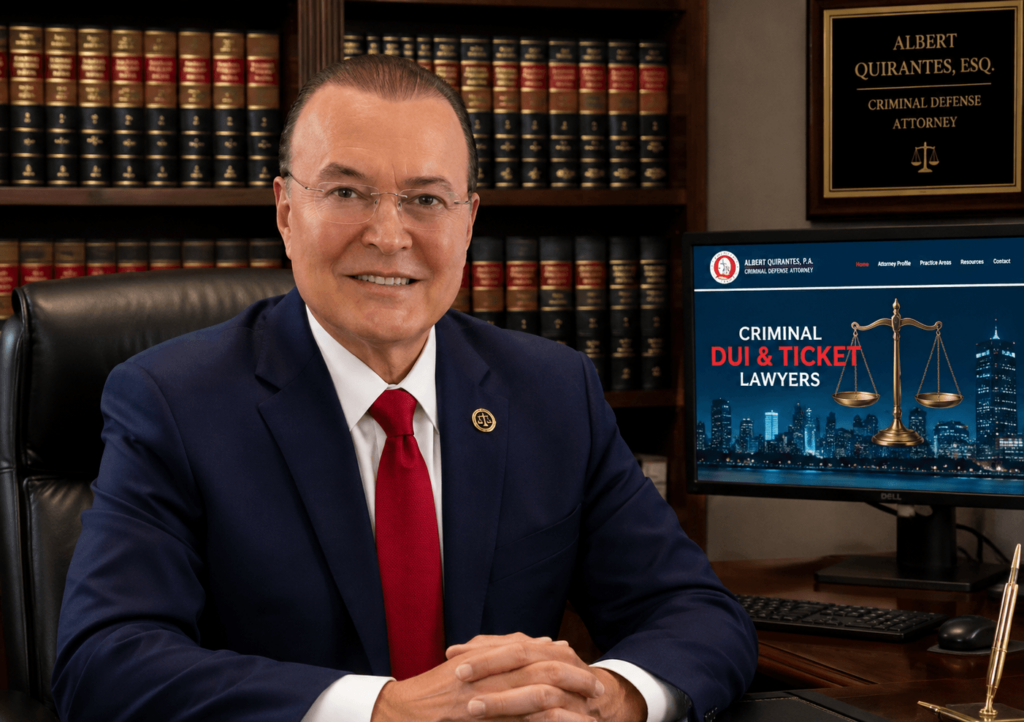
Albert Quirantes, Esq. and his criminal defense team defend people accused of disorderly conduct, breach of the peace, disorderly intoxication, and related charges. We represent adults and juveniles and examine whether the accusation concerns unlawful conduct, protected speech, mistaken identification, or lawful self-defense.
Don’t discuss the incident on a recorded jail call or social media. Preserve messages, videos, receipts, and witness contact information. Don’t delete evidence, pressure witnesses, or give an investigative statement without legal advice.
For a free strategy session with Albert Quirantes, Esq. Criminal DUI & Ticket Lawyers – A Law Firm, call or text 305-644-1800. Our office is at 1815 NW 7th Street, Miami, FL 33125. We serve clients in English and Spanish.
Represented since 1987
English and Spanish

Florida Statute 877.03 addresses breach of the peace, including brawling, fighting, and other specified conduct disturbing public order. It is a second-degree misdemeanor. The State must prove the charged offense beyond a reasonable doubt.
The statute’s broad wording does not give police unlimited authority to punish behavior they dislike. Constitutional limits and court decisions matter, especially when an accusation rests on words rather than physical acts. Being rude, attracting attention, or upsetting an officer doesn’t automatically establish the crime.
An incident at a privately owned business, parking lot, or other private property is not automatically outside the law. We examine what happened and its effect on the peace, rather than relying only on property ownership.

An arrest based mainly on speech deserves close scrutiny. In McDonough v. Garcia, a 2024 Eleventh Circuit decision, the court explained that angry words and profanity directed at police, without more, are insufficient for a disorderly conduct arrest. Bystanders simply stopping to watch do not turn lawful speech into incitement.
Speech that falls within a narrow unprotected category, such as fighting words, may receive different treatment. The exact words, actions, setting, and audience response matter. We assess the entire encounter, including what happened before officers began recording.

Disorderly Intoxication
Florida Statute 856.011 separately addresses intoxication endangering another person or property, and intoxication or drinking in a public place or public conveyance while causing a public disturbance. It is a second-degree misdemeanor. Drinking or appearing intoxicated alone is not enough to establish every required element.
Affray and Riot
Florida Statute 870.01 separately defines affray and riot. Affray involves mutually agreed fighting in a public place that terrifies the people and is a first-degree misdemeanor. Riot has additional statutory requirements and is a third-degree felony; aggravated forms carry greater penalties. A fighting allegation does not automatically change a section 877.03 charge into one of these offenses.
Other Allegations From the Same Incident
Battery, resisting an officer, trespass, traffic obstruction, or a municipal noise violation may require separate analysis. We review each charging document rather than assuming that one defense resolves every count. A person accused of several offenses may face exposure beyond the disorderly conduct penalty.
Ordinary disorderly conduct under section 877.03 can carry up to 60 days in jail and a fine of up to $500 under Florida Statute 775.082 and Florida Statute 775.083. These are statutory maximums, not a prediction of your sentence. Jail is not automatic merely because you were arrested.
A disposition may also involve court costs, supervision, community service, or other lawful conditions. Existing probation, release conditions, and additional charges can create separate concerns.
An arrest record may appear in background checks even when the prosecution ends favorably. Employment, licensing, education, and immigration questions should be considered before a plea. For a noncitizen, the exact charge, record, sentence, and immigration history require individual review; do not assume that a misdemeanor plea is harmless.
We defend allegations arising from bar and nightclub encounters, neighborhood disputes, sporting events, public gatherings, business confrontations, and police encounters. We also represent students and other juveniles accused of disturbances or fighting.
Our work may involve competing accounts of who started an encounter, whether the accused was trying to leave, whether a person was misidentified in a crowd, and whether the reported disturbance occurred at all. We handle cases originating in Miami, Miami Beach, Hialeah, Doral, Coral Gables, Homestead, North Miami, and other Miami-Dade communities.
1
Surveillance footage, body-camera video, dispatch recordings, and phone recordings may show a different sequence from the written report. We seek the full recording, including audio and events before the alleged disturbance. Early requests matter because businesses may overwrite video.
2
A report calling someone disruptive is a conclusion, not a substitute for facts. We compare the reported words and actions with the charged statute and applicable decisions. We examine who observed the event, how witnesses reacted, and whether accounts conflict.
3
We assess whether the case improperly treats criticism, an argument, or offensive language as criminal conduct. A First Amendment defense depends on the actual encounter; it should be grounded in recordings and testimony rather than a general claim that all speech is protected.
4
Being near a disturbance doesn’t establish that you caused it. We review clothing, camera angles, timestamps, witness descriptions, and individual actions. We separate the client’s conduct from what other people did.
5
When physical force is alleged, Florida Statute 776.012 may support a defense involving reasonably necessary force against imminent unlawful force. Other legal limits still apply. We investigate who initiated the encounter, available recordings, injuries, and the timing of the response. Verbal insults alone do not automatically justify physical violence.
6
We examine the grounds for detention, arrest, searches, and questioning. Florida Statute 901.15 governs warrantless arrests, including the ordinary misdemeanor presence rule and statutory exceptions. An unlawful procedure may support a motion when the facts and law permit it; it does not automatically erase every charge.
7
Depending on the evidence and eligibility, we may seek dismissal, a decision not to prosecute, diversion, a negotiated resolution, or trial. We explain the proposed terms and their consequences before you decide. No outcome should be promised before reviewing the case.

A school or neighborhood disturbance should be examined carefully before it becomes a juvenile delinquency case. Being present, arguing, or violating a school rule does not by itself prove disorderly conduct. Preserve school video, disciplinary notices, messages, and witness information promptly.
Florida Statute 985.12 provides for judicial-circuit prearrest delinquency citation programs for qualifying misdemeanors. The local program sets eligible offenses, criteria, and requirements. Participation is not automatic. We evaluate available alternatives and whether the evidence supports any charge before advising a family about an admission or program agreement.
Under Florida Statute 985.031, a child under seven cannot be arrested, charged, or adjudicated delinquent for an act committed before age seven, except for the statutory forcible-felony exception. Ordinary disorderly conduct does not fall within that exception.
If a delinquency petition proceeds, Florida Statute 985.35 generally provides for an adjudicatory hearing before a judge without a jury, with proof beyond a reasonable doubt. Juvenile outcomes and detention rules differ from adult misdemeanor sentencing. We also discuss school consequences and record issues; a juvenile record should not be assumed to disappear automatically at adulthood.
1
You may receive a notice to appear or be taken into custody. Keep every document and calendar the stated court date. Follow release conditions and arrange legal advice promptly.
2
The prosecutor decides whether and what to file. Defense counsel can present relevant evidence and identify weaknesses before or after that decision. An arrest label does not necessarily become the final charge.
3
The court addresses the formal charge and plea. Counsel can explain appearance requirements and whether a written plea or waiver is permitted. Do not miss a hearing because you assume your lawyer’s involvement excuses attendance.
4
We examine reports, recordings, witness statements, and the scene. We identify missing footage and compare the timeline with the State’s account.
5
Supported motions may challenge evidence, statements, or a legally deficient charge. Diversion and plea discussions depend on eligibility and the evidence. You decide whether to accept an agreement after receiving advice about its terms and consequences.
6
If the case proceeds to trial, the State must prove its case beyond a reasonable doubt. A case may instead end through dismissal, diversion, a negotiated plea, or another lawful disposition. We review the written outcome and any remaining obligations with you.
Albert Quirantes has practiced criminal defense for more than 35 years, represented more than 8,000 clients, and handled numerous jury trials. The firm has more than 1,400 five-star Google reviews and serves clients in English and Spanish from its Miami office.
The team includes Stephen Millan, a former Miami-Dade Circuit Court judge and former prosecutor; Arthur Spiegel, a former prosecutor and former public defender with more than 40 years of experience; Jorge E. Alonso, a bilingual attorney with more than 40 years of experience; and Jonathan Ibañez, a criminal defense trial lawyer whose work includes legal technology and AI-based defenses.
In a disorderly conduct case, careful review of a short recording, a witness’s assumption, or the precise charge can matter. Our defense team examines those details, explains the available options, and prepares to challenge the accusation in court when appropriate.
Albert Quirantes, Esq. Criminal DUI & Ticket Lawyers is located at 1815 NW 7th Street, Miami, FL 33125.

Profanity alone is not automatically a crime. Physical conduct and any legally unprotected speech must be examined separately. Preserve the complete recording and obtain advice about the specific encounter.
The ordinary section 877.03 offense is a second-degree misdemeanor. Separate felony charges from the same event have different elements and penalties.
No. A privately owned location does not by itself defeat the charge. The alleged conduct, witnesses, setting, and applicable law still matter.
Not by itself. Disorderly intoxication has additional elements involving danger or public disturbance. The prosecutor must establish the applicable requirements.
Yes, jail is legally possible, but the maximum is not an automatic sentence. Evidence, prior record, additional charges, and available resolutions affect the decision.
Possibly. Florida Statute 943.0585 and Florida Statute 943.059 govern judicial expunction and sealing. Eligibility depends on the disposition, prior record, and statutory exclusions. A dismissal does not itself delete the record. Review eligibility before entering a plea.
A qualifying local prearrest delinquency citation program may be available. Eligibility and requirements need review; there is no automatic entitlement in every case.
Bring the arrest report or notice to appear, court notices, release conditions, and any recordings or messages you already have. Provide witness contact information without coaching witnesses or asking them to change accounts.
If you or your child faces a disorderly conduct investigation or charge in Miami-Dade, call or text 305-644-1800 for a free strategy session with Albert Quirantes, Esq. Criminal DUI & Ticket Lawyers – A Law Firm.
1815 NW 7th Street, Miami, FL 33125. English and Spanish spoken. Explore our criminal defense practice areas.