









A conspiracy accusation can place someone at the center of a serious criminal case even when the planned offense was never completed, the person never handled drugs or money, or another participant performed the visible acts. Prosecutors often build these cases from text messages, recorded calls, financial records, social media, cooperating witnesses, surveillance, location data, and statements by alleged coconspirators.
Don’t try to coordinate stories, contact a witness, delete messages, move money, close an account, or explain your role to investigators without legal advice. Those actions can be misunderstood as consciousness of guilt or create additional allegations involving obstruction, witness tampering, or destruction of evidence.
A Miami federal and state conspiracy criminal defense lawyer can identify the exact agreement the government claims existed, separate association from criminal participation, test the reliability of informants, challenge searches and statements, and determine whether the evidence proves knowing and voluntary involvement. Early defense work is especially important when state and federal agencies are investigating the same conduct.
Answered around the clock. Free and confidential. English or Spanish.
Early defense work can preserve communications, identify the actual scope of the alleged agreement, challenge unreliable witnesses, protect digital evidence, and prevent avoidable mistakes.
For help from Albert Quirantes, Esq. Criminal DUI & Ticket Lawyers, call or text 305-644-1800 for a free strategy session.


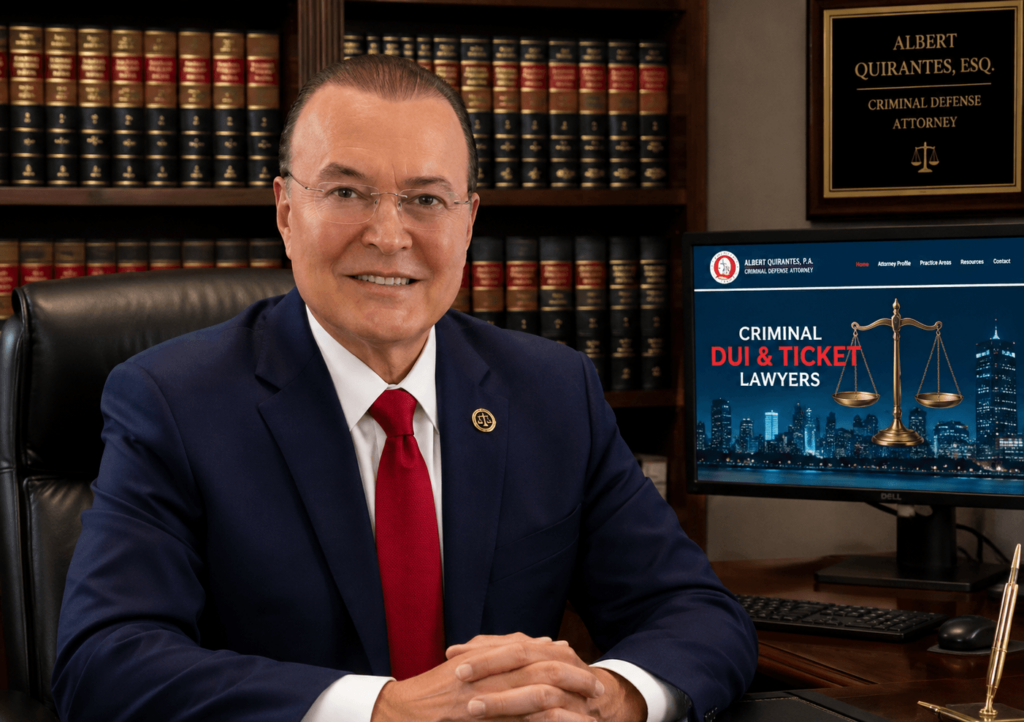
Albert Quirantes has practiced criminal defense for more than 35 years, represented more than 8,000 clients, and handled numerous jury trials. His firm has over 1,400 five-star Google reviews and serves clients in English and Spanish.
Albert Quirantes, Esq. represents Conspiracy Federal & State cases throughout Miami-Dade County, Broward County, and South Florida.
Call us now at (305) 644-1800 for a FREE STRATEGY SESSION
Represented since 1987
English and Spanish
What is criminal conspiracy under Florida law?
Under Florida Statute § 777.04, a person commits criminal conspiracy by agreeing, conspiring, combining, or confederating with another person to commit an offense. The State must prove the charged agreement and the required criminal intent; friendship, presence, knowledge, or association alone doesn’t automatically establish conspiracy.
What is a federal conspiracy charge?
18 U.S.C. § 371 covers agreements by two or more people to commit a federal offense or defraud the United States. It generally requires an act by at least one participant to advance the plan. Other federal laws create separate conspiracy offenses with different elements and penalties.
Can someone be charged if the planned crime was never completed?
Yes. Conspiracy punishes the alleged agreement itself. Completion of the target offense is not always required, although the government still must prove every element of the conspiracy statute used in the indictment or information.
Is an overt act always required?
No. General federal conspiracy under 18 U.S.C. § 371 ordinarily requires an overt act, but several special federal conspiracy statutes don’t. Florida’s general conspiracy statute focuses on the agreement and doesn’t state a separate overt-act requirement. The charging statute must be examined before assuming what the prosecution must prove.
Can state and federal prosecutors investigate the same alleged plan?
Yes. A multiagency investigation may produce Florida charges, federal charges, or both. Jurisdiction can depend on the target offense, interstate communications, federal programs, controlled substances, financial transactions, electronic evidence, and the agencies involved.
Is mere presence or association enough?
Not by itself. Being related to, employed by, or present with someone accused of crime doesn’t automatically prove an agreement. Prosecutors may rely on circumstantial evidence, however, so the full context of communications, conduct, timing, money, and claimed benefits must be examined.

Florida’s general conspiracy law appears in Florida Statute § 777.04. The State must identify an agreement to commit a specific unlawful act and prove that the accused knowingly intended to participate in that agreement. The crime is distinct from merely thinking about an offense, learning about someone else’s conduct, or being present when others discuss it.
An agreement doesn’t have to be written or formally announced. Prosecutors may try to infer it from coordinated conduct, coded communications, repeated transactions, shared proceeds, transportation, surveillance, or testimony from a participant. The defense can challenge whether the same facts have an innocent explanation or show only a buyer-seller relationship, employment activity, family contact, or conduct after the alleged plan was already complete.
Florida also recognizes a statutory defense based on complete and voluntary renunciation. Under Florida Statute § 777.04(5), a person charged with conspiracy must have persuaded the other participants not to commit the offense or otherwise prevented its commission under circumstances showing complete and voluntary renunciation. Simply walking away may not satisfy that demanding standard.
Some Florida statutes treat conspiracy more severely than the general ranking rules. Under Florida Statute § 893.135(5), a person who agrees or conspires to commit a prohibited trafficking act commits a first-degree felony and is punishable as though the trafficking act had been completed. The statute also permits separate convictions and sentences for qualifying conspiracy and completed-trafficking violations.
That means a drug-trafficking conspiracy may expose a person to penalties based on the substance and quantity attributed to the agreement, including mandatory minimum sentences and large statutory fines. The defense must examine what quantity and substance the accused actually agreed to, whether later conduct exceeded the scope of any agreement, and whether the government’s witnesses or recordings reliably establish the claimed plan.
Florida’s racketeering law separately makes it unlawful to conspire or endeavor to violate specified RICO provisions under Florida Statute § 895.03(4). A violation is a first-degree felony under Florida Statute § 895.04, and an alternative fine may be tied to the value gained or loss caused. RICO conspiracy cases require close analysis of the alleged enterprise, pattern, predicate offenses, participants, time period, and connection between the accused and the enterprise.
The general federal statute, 18 U.S.C. § 371, covers two kinds of agreements: a conspiracy to commit a federal offense and a conspiracy to defraud the United States or one of its agencies. The government generally must prove an agreement, knowing and voluntary participation, and an overt act by at least one conspirator to advance the object of the agreement. The overt act doesn’t always have to be criminal by itself.
Federal prosecutors also use offense-specific statutes. These laws can eliminate the overt-act requirement and expose a defendant to the same punishment authorized for the target offense. The exact indictment matters because the elements, defenses, mandatory minimums, forfeiture rules, and sentencing consequences can change with the statute selected.

Common federal conspiracy statutes
Other federal statutes create conspiracy offenses involving firearms, robbery, immigration, public corruption, identity theft, cybercrime, export controls, national security, and many other subjects. A defense should begin with the exact statutory text and the specific objects alleged in the charging document.
Under the general Florida ranking rules in Florida Statute § 777.04, conspiracy is ordinarily ranked below the target offense, but the result depends on the degree and sentencing level of that offense. A conspiracy involving a life or first-degree felony is generally a second-degree felony; many conspiracies involving second-degree or higher-ranked third-degree felonies are third-degree felonies. Special statutes can override those rules.
Ordinary Florida maximum penalties are described in Florida Statute § 775.082 and fines in Florida Statute § 775.083:
Those are statutory maximums, not predictions.
A general federal conspiracy under 18 U.S.C. § 371 ordinarily carries up to five years in prison, unless the object is only a misdemeanor, in which event the conspiracy punishment cannot exceed the misdemeanor’s maximum. Offense-specific statutes can carry much greater exposure, including mandatory minimums tied to the target crime.
Sentencing may be affected by the alleged role, duration, loss amount, drug quantity, number of participants or victims, use of a weapon, obstruction, prior record, acceptance of responsibility, and conduct attributed to the conspiracy. Federal sentencing can include relevant conduct beyond a single count, subject to the law, proof, and objections.
Courts may order restitution for qualifying losses under Florida Statute § 775.089 or federal law. Forfeiture may reach alleged proceeds or property used to facilitate specified offenses. A conviction can also affect immigration status, professional licensing, employment, security clearances, housing, education, firearm rights, travel, and business relationships. A noncitizen should obtain coordinated criminal and immigration advice before accepting any plea.
When the accused is under 18, a Florida conspiracy allegation is normally handled as juvenile delinquency under Florida Statute § 985.0301, but the target offense, age, prior record, and charging decision can create adult-court exposure. Conspiracy is not automatically a minor matter merely because the planned offense wasn’t completed.
Under Florida Statute § 985.557, prosecutors may directly file certain cases against 14- or 15-year-olds when the alleged offense is one of the serious crimes listed in the statute, including an attempt or conspiracy to commit the listed crime. Prosecutors have broader discretionary direct-file authority for many cases involving 16- or 17-year-olds, subject to the statute’s limits.
Juvenile defense should address detention, school, family supervision, digital communications, peer pressure, developmental maturity, alleged role, diversion eligibility, restitution, treatment needs, and the risk of adult prosecution. Parents should not arrange group conversations, ask a child to delete messages, or contact alleged participants to compare accounts.
Federal cases involving juveniles are governed by 18 U.S.C. §§ 5031 and 5032. Federal authorities generally must satisfy certification and transfer requirements before proceeding, and some serious allegations can lead to a request to transfer a juvenile for adult prosecution. Immediate review is necessary because federal and state juvenile procedures are very different.
1
A broad accusation isn’t enough. We compare the charging document, discovery, recordings, messages, witness accounts, and timeline to determine what offense was allegedly planned, who supposedly agreed, when the agreement began and ended, and whether the government’s theory changed during the investigation.
2
Family ties, friendship, employment, proximity, or repeated contact may explain why people communicated without proving a criminal agreement. We examine the purpose of each conversation and act, the accused person’s knowledge, and whether the evidence supports lawful business, social, or personal conduct.
3
A cooperating witness may seek a reduced sentence, payment, immigration consideration, release, or another benefit. We compare prior statements, plea agreements, criminal history, recorded conversations, phone data, financial records, and objective evidence to expose inconsistency, exaggeration, or motive to shift blame.
4
Even if some agreement existed, the accused may not have joined the larger plan alleged by prosecutors. We challenge whether there was one conspiracy or several, whether conduct occurred before entry or after withdrawal, and whether drugs, losses, victims, weapons, or acts by others were within the scope of any proven agreement.
5
Messages can be incomplete, translated poorly, taken out of sequence, or attributed to the wrong user. We review device extraction, account access, metadata, timestamps, deleted material, location records, banking activity, cryptocurrency, business records, and chain of custody to test authenticity and meaning.
6
Investigators must comply with constitutional and statutory requirements when obtaining phones, accounts, location data, homes, vehicles, financial records, wire communications, or statements. Where the facts and law support it, the defense can seek suppression, a hearing, or limits on improperly obtained evidence.
7
Florida’s statutory renunciation defense requires complete and voluntary action that prevents the offense or persuades the others not to proceed. Federal withdrawal has different requirements and consequences. Entrapment, lack of intent, impossibility issues, limitations, venue, duplicity, variance, and other defenses must be evaluated under the statute actually charged.
8
Multi-defendant cases create spillover risk because a jury may hear extensive evidence about other people. We assess severance, limiting instructions, admissibility of alleged coconspirator statements, plea consequences, cooperation demands, sentencing exposure, forfeiture, immigration effects, and trial strategy. The client decides whether to accept any resolution after receiving clear advice.
1
A conspiracy case may begin long before an arrest. Agents may use informants, undercover meetings, wiretaps, subpoenas, search warrants, surveillance, controlled transactions, or interviews. Don’t consent to extra searches, unlock devices, or give a detailed statement without legal advice.
2
Florida courts address probable cause, bond, stay-away conditions, travel, weapons, and contact with codefendants. Federal court uses a separate detention framework focused on appearance and community safety. A release plan may require verified residence, employment, family ties, medical needs, and conditions tailored to the actual allegations.
3
State prosecutors may file, reduce, expand, or decline charges after reviewing the investigation. Federal prosecutors ordinarily use a grand jury for felony indictments. The charging document should identify the conspiracy statute, time period, objects, participants alleged, and any substantive counts.
4
At arraignment, the accused receives the formal charge and enters a plea. Counsel can address discovery, protective orders, conflicts among codefendants, evidence preservation, language access, and deadlines for motions.
5
The defense reviews reports, recordings, warrants, affidavits, phone extractions, financial records, surveillance, witness statements, laboratory evidence, loss or quantity calculations, and plea agreements with cooperators. Independent investigators or forensic professionals may be necessary.
6
Motions may challenge searches, wiretaps, statements, identification, venue, joinder, prejudicial spillover, expert methods, hearsay, authentication, loss or quantity evidence, or legally insufficient allegations. Each motion requires a factual and legal basis.
7
Any proposal must be evaluated against the evidence, mandatory minimums, sentencing guidelines or scoresheet, role adjustments, cooperation terms, restitution, forfeiture, immigration, licensing, and codefendant consequences. No one should plead guilty before understanding the full agreement and likely sentencing issues.
8
If the case doesn’t resolve, the defense can require the government to prove every element beyond a reasonable doubt. A case may also end through a declined charge, no-action decision, dismissal, diversion where available, negotiated plea, acquittal, or other court ruling, depending on the facts and jurisdiction.
A conspiracy case may combine criminal intent, communications, informant testimony, digital evidence, financial analysis, sentencing law, and the conduct of many people. The defense must focus on what the accused actually knew, agreed to, and did—not on guilt by association.
Albert Quirantes is a Miami criminal defense lawyer who has defended people accused of serious crimes for more than 35 years. He has represented more than 8,000 clients and handled numerous jury trials. Albert Quirantes, Esq. Criminal DUI & Ticket Lawyers has over 1,400 five-star Google reviews and serves clients in English and Spanish from its Miami office.
The attorney team includes Stephen Millan, a former Miami-Dade Circuit Court judge and former prosecutor; Arthur Spiegel, a former prosecutor and former public defender with more than 40 years of experience; Jorge E. Alonso, a bilingual attorney with more than 40 years of experience who was born in Havana; and Jonathan Ibañez, a criminal defense trial lawyer whose work includes legal technology and AI-based defenses. The team brings courtroom experience, prosecutorial insight, local knowledge, and modern evidence analysis to Florida and federal conspiracy cases.
Albert Quirantes, Esq. Criminal DUI & Ticket Lawyers is located at 1815 NW 7th Street, Miami, FL 33125.

Yes. Conspiracy is a separate offense centered on the alleged agreement. The government doesn’t always have to prove that participants completed the planned offense, but it must prove every element of the conspiracy statute charged.
No. Prosecutors may try to prove an agreement through words, conduct, messages, money, travel, or coordinated acts. The defense can argue that the evidence shows lawful contact, independent conduct, or no shared criminal purpose.
Not necessarily. The answer depends on the government’s theory and the statute. A person may be accused of joining a broader plan without knowing every participant, but the government still must prove knowing and voluntary participation in the charged agreement.
Mere presence isn’t automatically enough. Presence combined with communications or conduct may be used as circumstantial evidence, so the defense must place the event in context and examine what the person actually knew and intended.
Yes, if admitted under the rules of evidence. Cooperators may have powerful incentives to help the government, so their prior statements, benefits, inconsistencies, criminal history, and objective corroboration require careful review.
Withdrawal rules are demanding and differ between Florida and federal law. Ending contact or remaining inactive may not be enough. Don’t contact alleged participants to announce a withdrawal without legal advice, because the communication may create new evidence or risk.
Sometimes. The answer depends on the statutes and the conduct charged. Florida’s trafficking statute expressly permits separate conspiracy and completed-trafficking convictions and sentences, while other situations require a different double-jeopardy and statutory analysis.
They can affect the charge, mandatory minimum, guideline calculation, fine, restitution, and forfeiture. The defense may dispute whether the amount was proven, foreseeable, and within the scope of the agreement the accused allegedly joined.
Yes. Immigration consequences depend on the conspiracy statute, target offense, plea language, factual basis, sentence, loss or drug allegation, and immigration status. Coordinated criminal and immigration review should occur before any plea.
Eligibility depends on the jurisdiction, exact charge, disposition, prior record, and statutory exclusions. Federal records generally don’t have the broad sealing and expungement process available for some Florida cases. Obtain an individual review before relying on record relief.
Don’t make a proffer, sign an agreement, contact targets, or perform controlled activity without independent legal advice. Cooperation can involve serious safety, credibility, sentencing, and self-incrimination consequences.
Early defense work can preserve communications, identify the actual scope of the alleged agreement, challenge unreliable witnesses, protect digital evidence, and prevent avoidable mistakes.
For help from Albert Quirantes, Esq. Criminal DUI & Ticket Lawyers, call or text 305-644-1800 for a free strategy session.