








A carjacking arrest can place your freedom, job, immigration status, and reputation at immediate risk. You may be frightened, confused, or convinced that the police arrested the wrong person after a fast-moving encounter.
What you do next matters. Don’t discuss the accusation on a recorded jail call, contact the alleged victim or witnesses, delete messages, or consent to a phone search without legal advice.
A Miami carjacking lawyer can preserve video, examine identification procedures, locate witnesses, and challenge weapon allegations before evidence disappears. If your case began in Miami, Miami Beach, Hialeah, Doral, Coral Gables, Homestead, North Miami, or another Miami-Dade municipality, early local defense work can shape the case.
Answered around the clock. Free and confidential. English or Spanish.
The sooner the defense starts, the sooner your lawyer can preserve video, investigate identification, challenge weapon evidence, and protect you from avoidable mistakes.
For help from Albert Quirantes, Esq. Criminal DUI & Ticket Lawyers, call or text 305-644-1800 for a free strategy session.



Albert Quirantes has practiced criminal defense for more than 35 years, represented more than 8,000 clients, and handled numerous jury trials. His firm enjoys more than 1,400 five-star Google reviews and serves clients in English and Spanish from its Miami office.
Represented since 1987
English and Spanish

Under Florida Statute § 812.133, carjacking is the taking of a motor vehicle from another person’s possession or custody with the intent to deprive that person of the vehicle, either temporarily or permanently. The State must also prove that force, violence, assault, or putting the person in fear occurred during the taking.
The alleged force doesn’t have to occur at the exact instant the vehicle changes hands. Florida law treats conduct before, during, or after the taking as part of the offense when the taking and force form a continuous series of acts or events.
Carjacking is different from ordinary motor-vehicle theft. Under Florida Statute § 812.014, theft of a motor vehicle is generally third-degree grand theft. Carjacking adds an allegation of force, violence, assault, or fear and is always charged as a first-degree felony.
The accusation becomes more serious when the State alleges a firearm, deadly weapon, discharge of a firearm, injury, multiple participants, or another offense during the event. The exact exposure depends on the charging document, evidence, weapon findings, criminal history, and other facts.
Carjacking without a firearm, deadly weapon, or other weapon is a first-degree felony under Florida Statute § 812.133. Under Florida Statute § 775.082 and Florida Statute § 775.083, the ordinary maximum is 30 years in prison and a fine of up to $10,000.
Carjacking with a firearm or other deadly weapon is a first-degree felony punishable by up to life in prison under Florida Statute § 812.133. A fine of up to $10,000 may also apply.
Florida Statute § 775.087 can require minimum prison terms when the State properly charges and proves qualifying firearm facts. The statute generally provides a 10-year minimum for actual possession of a firearm or destructive device during carjacking, a 20-year minimum if the firearm was discharged, and a minimum of 25 years to life if the discharge caused death or great bodily harm.
Actual possession of certain semiautomatic firearms with a high-capacity detachable box magazine, or a machine gun, can carry a 15-year minimum under the same statute. These minimums aren’t automatic in every case. The weapon, possession, discharge, injury, charging language, and required findings must be analyzed carefully.
An attempted carjacking may be charged under Florida Statute § 777.04. Because completed carjacking is a first-degree felony, an attempt is generally a second-degree felony, punishable by up to 15 years in prison and a fine of up to $10,000, although weapon laws and other allegations may affect the exposure.
Carjacking is listed as a dangerous crime under Florida Statute § 907.041. The State may seek pretrial detention when the statutory grounds and procedures apply, so release may involve much more than posting a scheduled bond.
A court may order restitution for damage, loss, medical expenses, or other qualifying harm under Florida Statute § 775.089. Probation, no-contact orders, firearm restrictions, and limits on contact with codefendants may also apply.
A carjacking charge doesn’t automatically suspend a Florida driver license. Still, related driving offenses, fleeing allegations, or separate court orders may affect driving privileges.
The consequences can continue after court. A felony case may affect employment, professional licensing, housing, education, firearm rights, and background checks. A noncitizen may face detention, inadmissibility, or removal concerns depending on the charge, facts, plea, and sentence, so immigration advice should come before any plea.
Our office handles a wide range of Carjacking cases in Miami-Dade, including:
1
Carjacking accusations often arise from a brief, frightening event. Poor lighting, stress, masks, crossfire between witnesses, suggestive photo lineups, and assumptions based on a vehicle or clothing can cause a mistaken identification.
We compare every description with surveillance video, body-camera footage, fingerprints, DNA, phone-location data, vehicle records, and witness accounts. We also examine how officers conducted any lineup or show-up procedure.
2
The State must prove more than an unauthorized taking of a vehicle. If the evidence doesn’t establish force, violence, assault, or putting another person in fear as part of a continuous series of events, the facts may not support carjacking, even if prosecutors pursue a different property charge.
3
Carjacking requires an intent to deprive another person of the vehicle temporarily or permanently. Permission, shared use, an ownership dispute, confusion over a rental or loan, or another good-faith explanation may undermine the required intent when supported by evidence.
4
Being near the scene, riding in a vehicle, or knowing another accused person doesn’t automatically prove participation. The State may use Florida Statute § 777.011 to argue that someone intentionally aided or encouraged the crime, so we test the evidence of knowledge, intent, words, and conduct.
5
A weapon allegation can change a 30 year maximum into possible life imprisonment and may trigger minimum terms. We examine whether the object was recovered, whether witnesses described it consistently, whether the accused actually possessed it, whether it was discharged, and whether forensic evidence supports the allegation.
6
Police may search a person, vehicle, home, phone, or account only when the law permits it. If officers obtained evidence through an unlawful stop, search, lineup, interrogation, or coerced statement, we can ask the court to suppress it when the facts and law support the motion.
1
After an arrest, law enforcement books the accused and submits reports and evidence to the Miami-Dade State Attorney’s Office. Don’t discuss the facts on a jail call, by text, on social media, with another detainee, or with anyone who may become a witness.
2
A person who remains in custody generally appears before a judge within 24 hours under Florida Rule of Criminal Procedure 3.130. The judge reviews probable cause and addresses release conditions, no-contact orders, weapons, locations, and codefendants.
Because Florida Statute § 907.041 classifies carjacking as a dangerous crime, the State may seek pretrial detention when the legal requirements apply. Defense counsel can challenge the evidence and detention grounds and present ties to Miami-Dade, employment, family responsibilities, history, and a proposed release plan.
3
An arrest doesn’t require the prosecutor to file the same charge listed on the arrest form. The State Attorney may file carjacking, change the charge, add counts or enhancements, or decline prosecution after reviewing the evidence.
Early defense work can preserve video, locate witnesses, document permission or ownership, examine identification problems, and address firearm claims before the filing decision.
4
At arraignment, the court states the formal charge and takes a plea. Counsel often files a written not-guilty plea and may waive the client’s appearance when the rules and judge permit it.
5
The defense reviews reports, 911 calls, body-camera recordings, surveillance video, lineup materials, vehicle evidence, phone data, fingerprints, DNA, firearm testing, medical records, and witness statements. We reconstruct the timeline and compare the State’s theory with the physical and digital evidence.
6
Depending on the facts, the defense may challenge detention, seek suppression of evidence or statements, attack an unreliable identification, request severance from a codefendant, exclude unfair evidence, or seek dismissal when the law and undisputed facts permit it. Each motion needs a factual and legal basis.
7
Any possible resolution depends on the evidence, injuries, weapon claims, criminal history, victim input, prosecutor, sentencing law, and the client’s goals. Carjacking’s felony classification and possible minimum sentences make careful review essential.
You decide whether to accept a plea after counsel explains the evidence, defenses, sentencing exposure, record consequences, and immigration risks. Don’t accept an agreement you don’t understand.
8
If the case doesn’t resolve, the defense can take it to trial and require the State to prove every element and any enhancement beyond the required legal standard. A case may also end through a no-action filing decision, dismissal, negotiated plea, reduced charge, or court ruling, depending on its facts.
Your goal is to protect your freedom, record, livelihood, and future. You need a defense team that can act quickly, challenge identification and weapon evidence, and prepare a serious felony case for litigation from the start.
Albert Quirantes has practiced criminal defense for more than 35 years, represented more than 8,000 clients, and handled numerous jury trials. His firm enjoys more than 1,400 five-star Google reviews and serves clients in English and Spanish from its Miami office.
The attorney team includes former Miami-Dade Circuit Court judge and former prosecutor Stephen Millan, former prosecutor and former public defender Arthur Spiegel, bilingual attorney Jorge E. Alonso, and criminal defense trial lawyer Jonathan Ibañez, whose work includes legal technology and AI-based defenses. The team brings courtroom experience, prosecutorial insight, local knowledge, and modern evidence analysis to Miami-Dade carjacking cases.
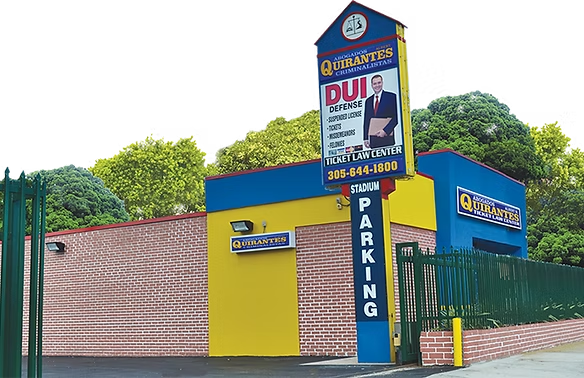
Albert Quirantes, Esq. Criminal DUI & Ticket Lawyers is located at 1815 NW 7th Street, Miami, FL 33125.

Carjacking requires a taking from another person’s possession or custody through force, violence, assault, or fear. Stealing an unattended vehicle may support a grand theft charge, but it doesn’t automatically satisfy the elements of carjacking.
Yes. Physical injury isn’t a required element if the State claims that force, violence, assault, or putting the person in fear occurred. The absence of injury may still matter when testing the account, weapon claim, sentencing position, and related charges.
The State still must prove the weapon allegation it charged. Statements, video, recovered objects, fingerprints, DNA, ballistics, and witness consistency can matter when deciding whether prosecutors can prove actual firearm possession or another weapon beyond a reasonable doubt.
No. Florida Statute § 775.087 applies only when its charging, proof, possession, discharge, injury, and finding requirements are met. A lawyer should examine each requirement rather than assume the arrest report controls the sentence.
Possibly. Prosecutors may allege that a passenger intentionally aided, encouraged, or participated in the crime under Florida’s principal law. Mere presence isn’t the same as intentional participation, so the passenger’s knowledge, statements, conduct, and timing matter.
Misidentification is a real defense issue, especially when the encounter was brief, stressful, dark, or obstructed. The defense can examine lineup procedures and compare the identification with video, phone data, physical evidence, alibi witnesses, and earlier descriptions.
The alleged victim doesn’t control whether the State files or continues a criminal case. The Miami-Dade State Attorney’s Office makes that decision, although the witness’s cooperation, credibility, and wishes may affect the evidence and negotiations.
Don’t contact or pressure the person about the case. That can violate a court order, harm the defense, or lead to a new allegation.
Yes. An attempt generally requires an act toward committing carjacking that fails or is interrupted, not just discussion or preparation. Under Florida Statute § 777.04, attempted carjacking is generally a second-degree felony, although the exact charges and weapon issues matter.
Pretrial release isn’t automatic. Florida lists carjacking as a dangerous crime, and the State may seek detention under Florida Statute § 907.041 when the required grounds exist. The defense can contest the request and present a lawful release plan.
Yes. A felony disposition can create major barriers to sealing or expungement, and a noncitizen may face serious immigration consequences depending on the charging language, facts, plea, and sentence. Get case-specific criminal and immigration advice before accepting any plea.
The sooner the defense starts, the sooner your lawyer can preserve video, investigate identification, challenge weapon evidence, and protect you from avoidable mistakes.
For help from Albert Quirantes, Esq. Criminal DUI & Ticket Lawyers, call or text 305-644-1800 for a free strategy session.