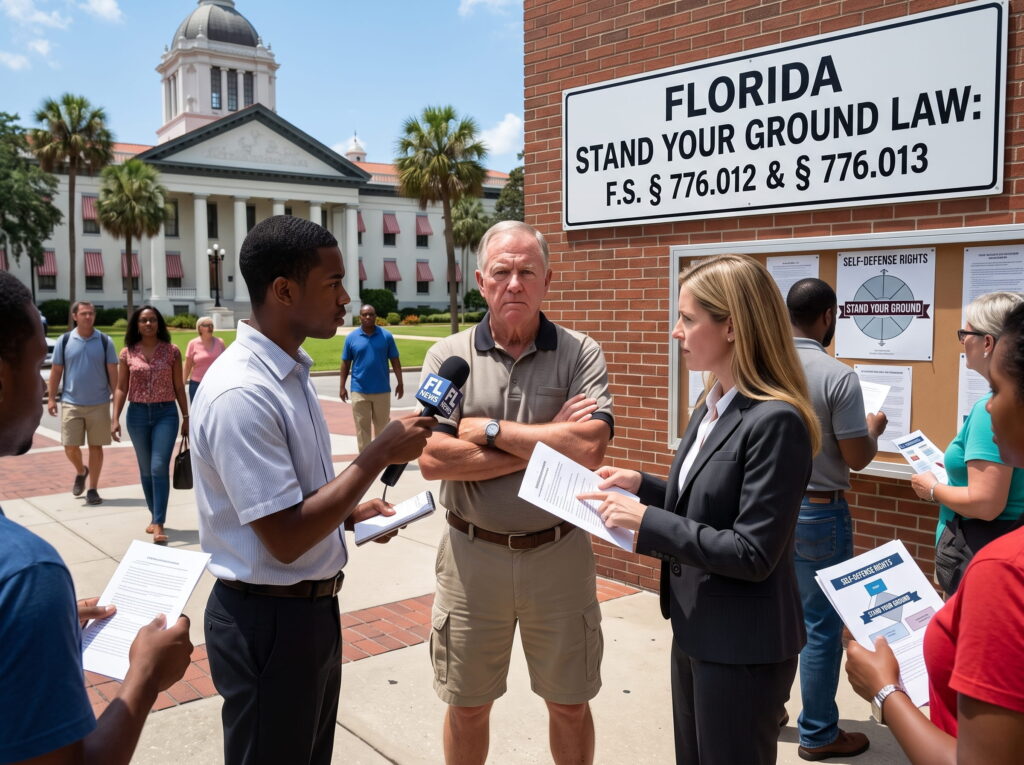








Stand Your Ground in Florida: When You Can Use Deadly Force and What the Law Really Requires
A self-defense case in Florida can turn on a few critical details.
Where were you? What happened immediately before the force was used? Were you facing an immediate threat? And did you have a legal right to be there?
Florida’s Stand Your Ground law can provide significant protection when its requirements are met. But it does not give someone automatic permission to use deadly force whenever they feel threatened.
The details matter. A lot.
What Is Florida’s Stand Your Ground Law?
Florida’s Stand Your Ground law was enacted in 2005 and has been strengthened over the years. One of its biggest changes was removing the general duty to retreat before using lawful force.
Under Florida Statute 776.012, a person who is not engaged in criminal activity and is in a place where they have a legal right to be generally has no duty to retreat before using force.
That can include deadly force.
But there is an important condition: the person must reasonably believe that using the force is necessary to prevent imminent death or great bodily harm, or to stop the imminent commission of a forcible felony.
So, simply saying, “I was scared,” is not enough.
The circumstances surrounding that fear matter.
What Do You Have to Prove to Claim Stand Your Ground?
Florida’s general self-defense rule focuses on several key questions.
Were You Legally Allowed to Be There?
The law applies when you are in a place where you have a legal right to be.
Were You Engaged in Criminal Activity?
Stand Your Ground protection has limitations when the person claiming self-defense was engaged in criminal activity at the time of the incident.
Did You Face an Imminent Threat?
The threat must involve imminent death, great bodily harm, or the imminent commission of a forcible felony.
That means the timing matters. The law is concerned with what was happening when the force was used—not simply what happened earlier or what someone feared might happen later.
Was Your Belief Reasonable?
This is one of the most important parts of the analysis.
The question isn’t only what you personally believed. The law looks at whether that belief was reasonable under the circumstances.
Imagine two people arguing in a parking lot. One person makes an angry comment, but there is no immediate physical threat. If the other person responds with deadly force, claiming fear alone may not establish the legal justification required for Stand Your Ground.
Now change the facts. Suppose the confrontation involves an immediate threat of serious violence.
Those details can change the legal analysis.
Context matters.
Florida’s Castle Doctrine Provides Additional Protection
If the incident happened inside your home or another covered location, a different part of Florida’s self-defense law may apply.
Florida Statute 776.013, Florida’s Castle Doctrine provision, addresses situations involving a person’s dwelling, residence, or occupied vehicle.
Under the statute, when someone unlawfully and forcibly enters—or attempts to enter—one of these protected places, the law provides a presumption of reasonable fear under the circumstances described by the statute.
That can make a major difference in a self-defense case.
However, the presumption is not unlimited. Florida law includes specific exceptions, so the exact facts of the incident still need to be examined carefully.
In other words, being inside your home does not automatically end the legal analysis. It changes the framework.
Stand Your Ground Can Be More Than a Trial Defense
Many people think of self-defense as something that gets argued before a jury.
Florida’s Stand Your Ground law can provide another option.
Under Florida Statute 776.032, a person who uses force as permitted by law may be immune from criminal prosecution and civil action.
That means a Stand Your Ground immunity motion can potentially be raised before trial.
How Does a Stand Your Ground Immunity Hearing Work?
This is where the procedure becomes especially important.
Since a 2017 change to the law, once the defense presents a prima facie claim of self-defense at the immunity hearing, the burden shifts to the prosecution. The state must then prove by clear and convincing evidence that the defendant is not entitled to immunity.
That can be a significant part of the case.
The Florida Supreme Court addressed this burden-shifting rule in Love v. State, holding that the rule applies retroactively to incidents that occurred before the 2017 change.
What Happens If the Judge Grants Immunity?
If the judge grants Stand Your Ground immunity, the criminal charges are dismissed.
There is no trial on those charges. No jury verdict. No conviction.
If the judge denies the motion, however, that does not necessarily end the self-defense argument. The defense may still present Stand Your Ground or self-defense evidence at trial, depending on the facts and applicable law.
That is why the immunity hearing can become a major strategic issue in a use-of-force case.
When Does Stand Your Ground Not Apply?
Stand Your Ground protection has limits.
Florida law addresses situations involving:
- A person who provoked the confrontation
- Someone engaged in criminal activity
- Certain encounters involving law enforcement officers performing their duties
- Force that is disproportionate to the threat involved
These issues can become highly fact-specific.
A few seconds of video, a witness statement, or what happened immediately before the confrontation may become extremely important.
What Happens If You Were the Initial Aggressor?
Being the person who started a confrontation can create a serious problem for a self-defense claim.
But Florida’s law provides specific exceptions.
Florida Statute 776.041 addresses the use of force by an initial aggressor and identifies circumstances in which the person may regain the right to claim self-defense.
For example, that can happen when:
- The force used against the initial aggressor escalates to a level involving imminent death or great bodily harm, and the person has exhausted every reasonable means of escape; or
- The person withdraws from the confrontation in good faith and clearly communicates that they are withdrawing, but the other person continues or resumes the threat.
This is one reason the entire sequence of events matters.
A case cannot always be understood by looking at the final moment alone.
What happened first? Who escalated the confrontation? Did someone try to leave? What did the other person do next?
Those questions can become central to the defense.
The Evidence Can Make or Break the Case
A Stand Your Ground claim is rarely decided by one sentence.
Evidence matters.
That can include:
- Surveillance footage
- Witness statements
- Physical evidence
- Photographs of injuries or the scene
- Communications between the people involved
- Prior history between the parties
- Other evidence showing what happened immediately before the force was used
For example, a surveillance camera may show only the final few seconds of an encounter. Another camera may capture what happened several minutes earlier.
Those missing minutes can matter.
A defense attorney needs to look at the complete factual record, not just the version of events presented at the initial investigation.
Should You Give Police a Statement After a Self-Defense Incident?
This is where people often make decisions they later regret.
After a shooting or other serious use-of-force incident, police will want to know what happened. It is natural to think that explaining everything immediately will make the situation clearer.
But you have the right to remain silent and speak with an attorney first.
A statement given while you are frightened, angry, exhausted, or still processing what happened can create problems later. A small inconsistency may be compared against surveillance footage, physical evidence, witness statements, or other evidence gathered during the investigation.
You do not have to decide the entire case at the scene.
A safer approach is to tell law enforcement that you will cooperate after speaking with your attorney, then contact counsel as soon as possible.
What Should You Do After a Use-of-Force Incident?
If you are involved in a Florida incident where force was used, several practical steps are important:
Preserve Evidence
Do not destroy, alter, or discard potential evidence. Photographs, messages, videos, and other records may become important later.
Avoid Discussing the Incident Publicly
Social media posts, text messages, and casual conversations can become part of an investigation.
Speak With a Criminal Defense Attorney
A lawyer can review the facts, identify potential Stand Your Ground issues, and determine whether seeking pretrial immunity makes sense in the particular case.
Do Not Assume the Case Is Over Because You Acted in Self-Defense
Self-defense and Stand Your Ground are legal issues that depend on the circumstances.
The sooner those circumstances are carefully reviewed, the better prepared the defense can be.
Facing a Stand Your Ground Case in Florida?
A use-of-force investigation can move quickly. What you say, what evidence is preserved, and how the facts are presented can all become important.
If you have been involved in a use-of-force incident in Florida, contact Albert Quirantes, Esq. at (305) 644-1800 before speaking with police or prosecutors.
Our firm handles Stand Your Ground cases in Miami-Dade and Broward and is available 24/7.
Sources
- Florida Statute 776.012 — general Stand Your Ground provision and the no-duty-to-retreat rule
- Florida Statute 776.013 / Chapter 776, current codification — Castle Doctrine provisions involving dwellings, residences, and occupied vehicles
- Florida Statute 776.032 — immunity from prosecution and the 2017 burden-shifting amendment
- Love v. State, Florida Supreme Court (2019) — addresses the retroactive application of the 2017 burden-shifting rule
- Florida Statute 776.041, Law of Self Defense — initial aggressor rule and exceptions